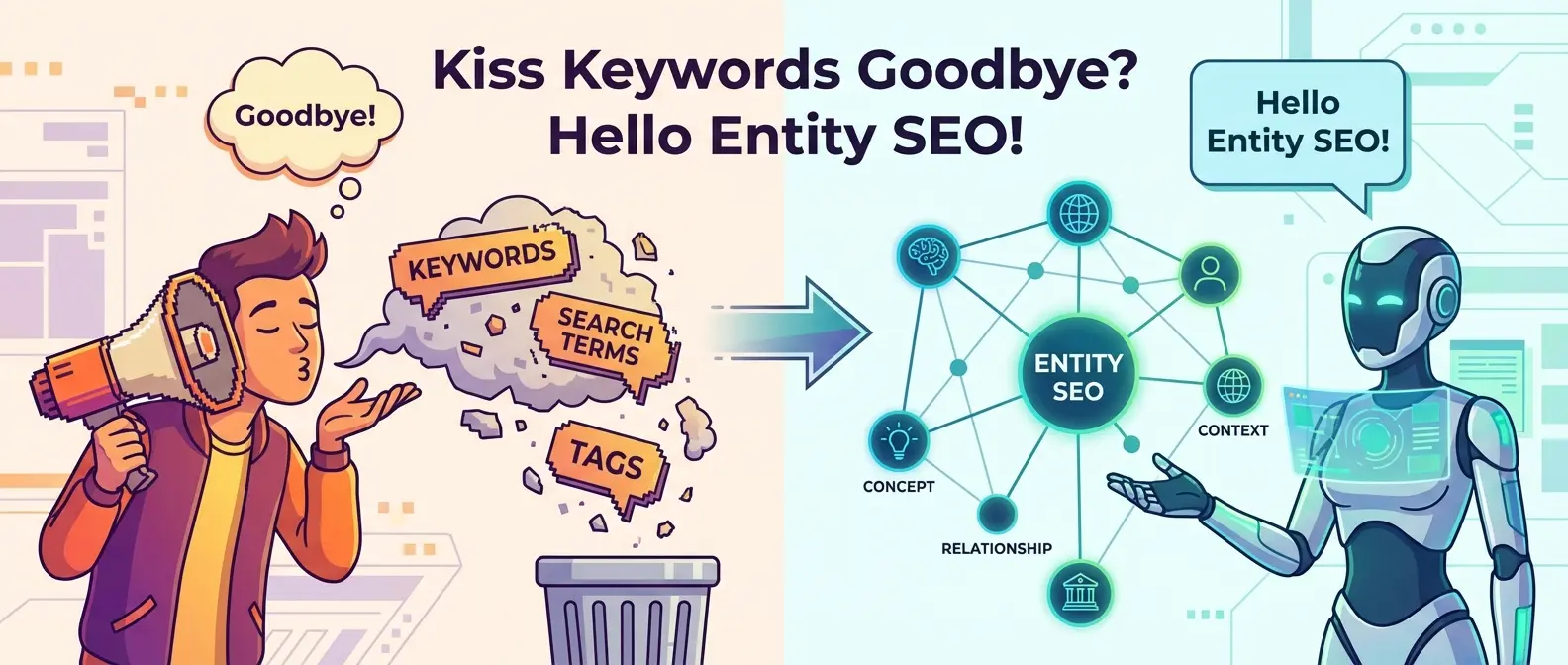
Kiss Your Keywords Goodbye? Why Entity SEO Is Your New Best Friend
Remember the good ol’ days of SEO? You’d pick a keyword, stuff it into a page about 47 times, and hope for the best. I once saw an article that read, “Looking for the best red widgets? Our best red widgets are the best red widgets you can buy.” It was a wild time. Thankfully, Google grew up, and now it’s time for our SEO strategies to do the same. The new king of the castle isn’t just a “keyword” anymore; it’s a whole “topic,” and the cool kids call it Entity SEO.
So, What in the World is an “Entity”?
Imagine your brain is a giant, messy spiderweb. When you think of “Paris,” you don’t just see the word. You instantly connect it to other things: the Eiffel Tower, croissants, the Louvre, maybe even that one time you got lost on the Métro. An “entity” is just like that in Google’s brain. It’s not just a word; it’s a whole concept—a person, place, thing, or idea that Google understands and can connect to other concepts.
This is all powered by the mighty Google Knowledge Graph, which is basically Google’s massive digital encyclopedia of everything. It’s how Google knows that Leonardo da Vinci (an entity) painted the Mona Lisa (another entity) which is located in The Louvre (yet another entity). It’s all about connections, relationships, and context.
The Magic Trick: It’s Called Semantic Search
How does Google make all these fancy connections? With a little bit of magic called semantic search. Instead of just matching the exact words you type, semantic search tries to understand your intent. It asks, “What does this person really want to know?”
For example, if you search for “what’s the best bat?”, are you a baseball player looking for gear, a biologist studying mammals, or a vampire with high standards? Semantic search looks at other clues—like if you also mention “cave” or “MLB”—to figure out the context and give you the right answer. It’s less like a dictionary and more like a helpful librarian who actually understands what you’re asking for.
Alright, So Are Keywords Officially Dead?
Hold your horses! Let’s not plan a funeral for keywords just yet. They aren’t dead, but they have been demoted. They’re no longer the star quarterback; they’re more like a valuable player on a much larger team—the “topic team.” You still need them, but they can’t win the game on their own. Instead of obsessing over one specific keyword, we now need to focus on covering a topic so thoroughly that all the relevant keywords just naturally show up to the party.
My Super-Simple Guide to an Awesome Entity SEO Strategy
Feeling a little overwhelmed? Don’t be! Building an effective entity SEO strategy is actually pretty fun. It’s about being genuinely helpful, not just trying to trick a robot. Here’s how you can get started:
- Think in Webs, Not Lines: Before you write, brainstorm! What’s your main topic? Now, what are all the related sub-topics, common questions, and interesting tangents? Think like you’re creating a Wikipedia page, not just a blog post. Cover the topic from every angle.
- Become the Authority: Your goal is to be the most comprehensive, helpful resource on a given topic. If you’re writing about baking sourdough, don’t just give a recipe. Explain starters, different types of flour, proofing techniques, and what to do when it all goes horribly wrong. Answer every possible question a user might have.
- Connect the Dots: Use internal links to connect your related articles. If you have a post about sourdough starters, link to it from your main sourdough recipe post. This creates a logical web of information on your site, showing Google that you’re an expert on the whole topic, not just one little piece of it.
- Spoon-Feed Google with Structured Data: This sounds scarier than it is. Structured data (or schema markup) is a bit of code you can add to your site to explicitly tell Google what your content is about. It’s like putting a label on a box that says, “Hey Google, this is a recipe!” or “This is a product review!” This helps Google understand your content faster and more accurately, which can help it land in the Google Knowledge Graph.
At the end of the day, this shift is a huge win for everyone. It forces us creators to make better, more helpful content, and it helps users find the answers they’re actually looking for. So stop stuffing keywords and start building your own little knowledge empire. Your audience—and your rankings—will thank you for it.