Look, the sandbox is comfortable. I get it.
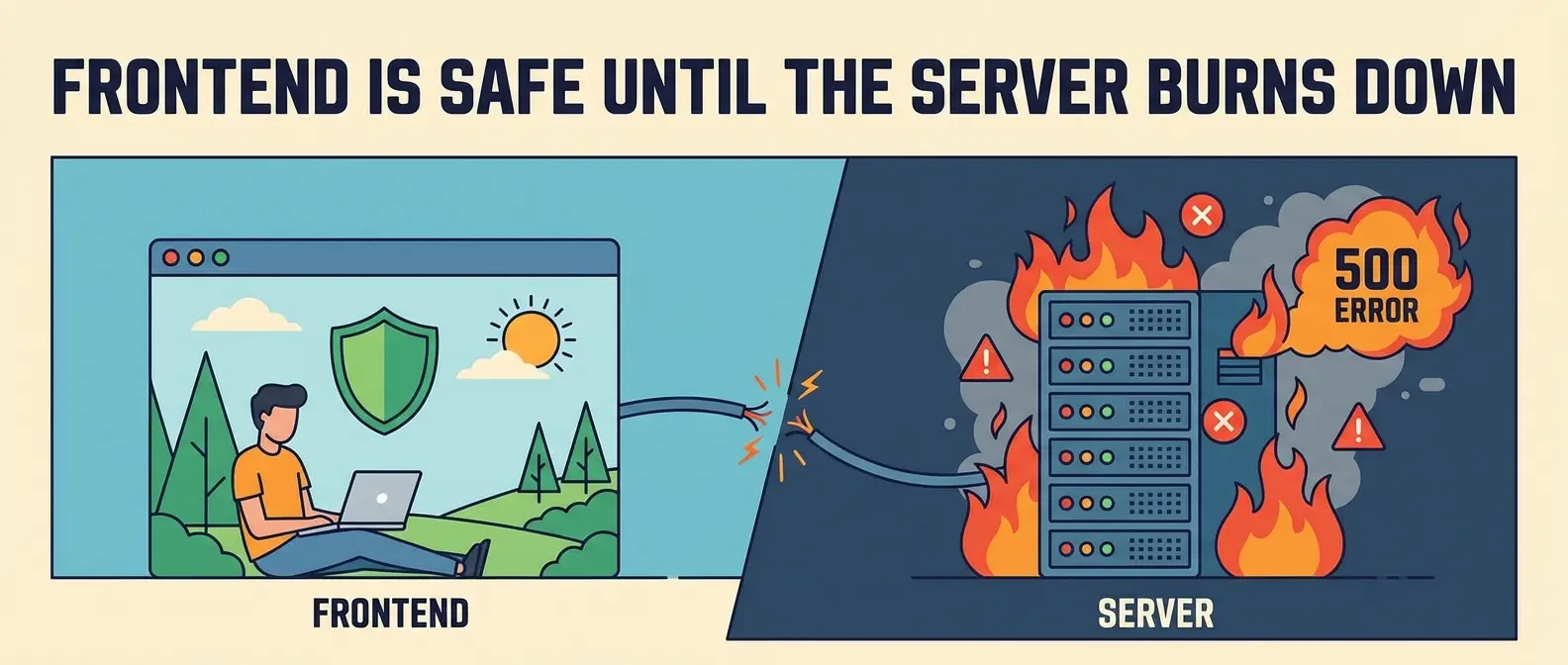
I know why you became a frontend developer. It feels safe here. You tweak a CSS rule, the button turns blue, and you get that instant hit of dopamine. It’s visual. It’s tangible. It’s like being a barista who only has to worry about the latte art, ignoring the fact that the espresso machine behind you is currently on fire and spraying hot steam into the customers’ faces.
But here is the cold, hard truth: staying purely in frontend is a career trap. It’s comfortable right up until the moment it isn’t.
I’m not saying you need to abandon your React components to become a database administrator. Please, don’t do that. But if you treat the backend like a magical black box where data goes in and JSON comes out, you are going to hit a ceiling so hard you’ll see stars. Understanding backend skills is no longer optional. It’s the difference between being a developer and being a pixel-pusher.
The “It’s Not My Problem” Fallacy
We’ve all been in that standup meeting. The API returns a 500 error. The frontend dev shrugs, takes a sip of their lukewarm brew, and says, “Well, the UI is fine. Backend team needs to fix it.”
That attitude is why projects fail. When you refuse to understand how the server works, you are coding blindfolded. You don’t know why your API calls are timing out. You don’t understand why fetching 10,000 records at once crashed the browser and the server. You are creating problems you aren’t equipped to solve.
I’ve written before about how the Full-Stack Unicorn is Dead. I stand by that. You don’t need to be an expert in everything. You don’t need to be the person configuring the Kubernetes cluster while designing the logo. But you simply cannot ignore the other half of the application.
Stop Leaking Data Everywhere
Here is where things get scary. Pure frontend devs are often dangerous. I don’t mean they carry knives; I mean they leave the digital front door wide open.
If you don’t understand how authentication works on the server, you’re going to mess it up on the client. I’ve seen senior frontend devs store JWTs in local storage like they’re collecting digital pogs, completely ignoring security basics that leave the app vulnerable to XSS attacks. You need to know what a secure cookie is. You need to know why CORS exists (and no, the solution isn’t just installing a browser plugin to bypass it).
Your Career Depends on It
Let’s look at the job market. It’s ugly out there. The days of getting hired just because you know how to center a div are over. The industry is flooded with bootcamp grads who can build a Todo list in three different frameworks. To stand out, you need depth.
If you want to keep surviving web development in 2025, you need to be the person who can debug the whole stack. When the app crashes at 2 AM, the company doesn’t want to wake up two people. They want to wake up one person who can figure out if it’s a React render loop or a database deadlock.
The “No-Code” Threat is Real-ish
If your entire job is just moving visual elements around, guess what? A robot or a drag-and-drop tool can do that faster than you. The siren song of no code is loud, and management loves it because it’s cheap. The logic, the data handling, the complex integrations—that is where the value lives. That is what keeps you employed.
Where to Start (Without Losing Your Mind)
You don’t need to learn Rust overnight. Start small. Full stack development is a spectrum, not a binary switch.
- Learn SQL: Stop fearing the database. Write a raw query. See how the data actually lives.
- Build a simple API: Use Node.js. You already know JavaScript. Spin up an Express server. It’s not rocket science.
- Type everything: If you are still writing raw JS, stop. Use TypeScript as insurance against your 2AM stupidity. It forces you to think about data structures, which is half the battle of backend dev.
The goal isn’t to switch teams. The goal is to stop being helpless when the server catches fire. So, go pour another cup of coffee—make it a double—and go break something on the backend. It’s the only way you’ll learn.