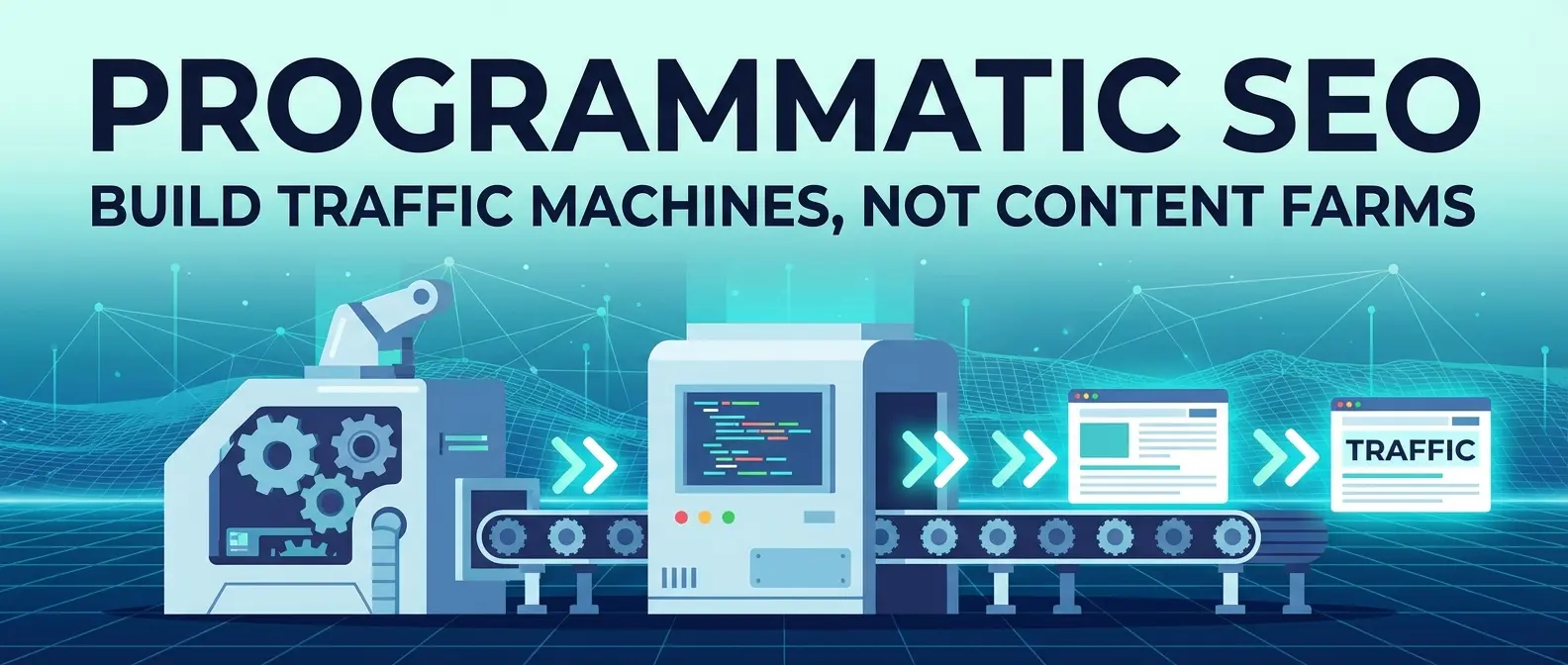
Programmatic SEO: How to Generate Massive Organic Traffic Without Writing 10,000 Articles by Hand
I’m going to let you in on a dirty little secret. That competitor who’s ranking for 47,000 keywords? They didn’t write 47,000 blog posts. They’re not running a content sweatshop. They built a system. And that system has a name: programmatic SEO.
Before you roll your eyes and assume this is some black-hat garbage that’ll get you slapped by Google, hear me out. Programmatic SEO is completely legitimate when done right. It’s also completely useless when done wrong. I’ve seen both outcomes. The difference usually comes down to whether you actually understand what you’re building.
What Is Programmatic SEO, Really?
Programmatic SEO is the practice of creating thousands of pages using templates and databases instead of typing each one individually like some medieval scribe. Think of it this way: instead of writing “Best coffee shops in Austin,” “Best coffee shops in Portland,” and “Best coffee shops in Seattle” as three separate articles, you create one template and let your data do the heavy lifting.
Zapier does this brilliantly. So does Nomad List. And Yelp. And Tripadvisor. And basically every successful directory site you’ve ever used.
The concept is simple. The execution? That’s where most people faceplant into their keyboards.
The Three Pillars of Programmatic SEO That Actually Matter
1. Your Data Is Everything
Here’s the uncomfortable truth: your content strategy lives or dies based on your data quality. Garbage data equals garbage pages equals Google treating your site like digital landfill.
You need data that’s:
- Unique (scraped content is a fast track to de-indexing)
- Structured (messy data creates messy pages)
- Valuable (does this actually help someone?)
- Scalable (can you add more without rebuilding everything?)
Where do you get good data? APIs are gold. Government databases are underrated. Proprietary research is chef’s kiss. User-generated content works if you have the traffic to generate it. Which is a chicken-and-egg problem I’ll address later.
2. Templates That Don’t Suck
Your template is the difference between a helpful page and a thin content wasteland. I’ve seen programmatic pages that are literally just “Welcome to {city}! Here are {number} things about {topic}.” That’s not content. That’s a Mad Libs crime scene.
Good templates include:
- Dynamic content blocks that change based on data
- Conditional logic (if data point X exists, show Y)
- Internal linking structures that make sense
- Genuine value additions like comparisons, calculations, or insights
The goal isn’t to trick Google into thinking a robot wrote human content. The goal is to create genuinely useful pages that happen to be generated efficiently. Big difference.
3. Technical SEO That Doesn’t Implode at Scale
Here’s where things get spicy. Creating 50,000 pages is easy. Making sure Google can actually crawl, index, and rank them? That’s the hard part.
You need to obsess over site speed. If you’re running WordPress and wondering why your programmatic pages load like molasses, you might want to look into Redis object caching to stop your database from crying. Repeated queries at scale will murder your server.
While you’re at it, those product images or location photos you’re dynamically loading? They’re probably embarrassing. Seriously, your PNGs need a reality check. At scale, poor image optimization compounds into a genuine disaster.
The Content Strategy Nobody Talks About
Most programmatic SEO tutorials focus on the “programmatic” part and ignore the “SEO” part. Big mistake.
You still need keyword research. You still need search intent analysis. You still need to understand why someone would click on your page over the million other options. The only difference is you’re doing this research once for a template, not once per page.
Here’s my process:
First, find a keyword pattern with massive search volume spread across many variations. “{City} + {service}” is classic. “{Product} vs {product}” is another winner. “{Topic} statistics {year}” works great if you have fresh data.
Second, analyze the top three results for a sample keyword. What do they include? What’s missing? Can your template provide something better?
Third, map your data to actual search intent. Having data about average temperatures is useless if people searching “{city} weather” want forecasts, not historical averages.
SEO Tools That Actually Help
I’m not going to pretend you can do this with a spreadsheet and dreams. You need proper SEO tools.
For keyword research at scale, Ahrefs and SEMrush are the obvious choices. Neither is cheap. Both are worth it for programmatic projects. The ability to export thousands of keywords and analyze patterns is non-negotiable.
For technical SEO auditing, Screaming Frog handles crawling large sites without breaking a sweat. When you’ve got 20,000 pages, you need to know which ones are returning 404s, have duplicate titles, or are missing meta descriptions.
For tracking Google ranking at scale, I use a combination of Search Console (free, essential) and Ahrefs rank tracking (not free, but powerful). You need to know which templates are working and which are flopping.
The Build Itself: Options That Don’t Suck
You’ve got choices here. None of them are perfect.
WordPress with custom post types and Advanced Custom Fields can work. It’s not elegant, but if you already know WordPress, building custom blocks with React opens up some interesting possibilities for programmatic content templates.
Static site generators like Next.js or Gatsby are faster but require actual development chops. The upside? Your pages load instantly. The downside? You need to rebuild the entire site when data changes. At 50,000 pages, that rebuild time adds up.
If you’re going the React route anyway, understanding React Server Components matters here. Bundle size at scale affects everything.
The Traffic Truth
Let me be honest about organic traffic expectations. Programmatic SEO is a long game. You’re not going to publish 10,000 pages today and swim in traffic tomorrow.
Google needs time to crawl your pages. Then time to index them. Then time to evaluate their quality. Then time to rank them. This process takes months, not days.
I’ve seen programmatic projects take 6-8 months before showing meaningful traffic. That’s not failure. That’s normal. The magic happens when thousands of pages start ranking for thousands of long-tail keywords simultaneously. Individual pages might only get 50 visits per month, but 10,000 pages times 50 visits equals 500,000 monthly visitors.
That math changes everything. It’s similar to why high-ticket affiliate marketing beats grinding for pocket change—you want leverage, not labor.
The Mistakes That Will Destroy You
I’ve watched programmatic SEO projects crash and burn. Here’s what kills them:
- Thin content. If your pages are just data displayed differently, Google will ignore them.
- No internal linking. 50,000 orphan pages might as well not exist.
- Duplicate or near-duplicate content. Templates need meaningful variation.
- Ignoring mobile. This isn’t 2008.
- Zero promotion. Even programmatic content needs initial signals.
Is This Actually Worth It?
Programmatic SEO isn’t for everyone. It requires upfront investment in data, development, and patience. If you need traffic next week, this ain’t it.
But if you have unique data, technical capability (or budget to hire it), and a long-term mindset? Programmatic SEO can generate more organic traffic than any other strategy I’ve used.
The companies crushing it with programmatic SEO aren’t doing anything magical. They’re doing the boring work correctly at scale. That’s it. That’s the secret.
Now go build something.