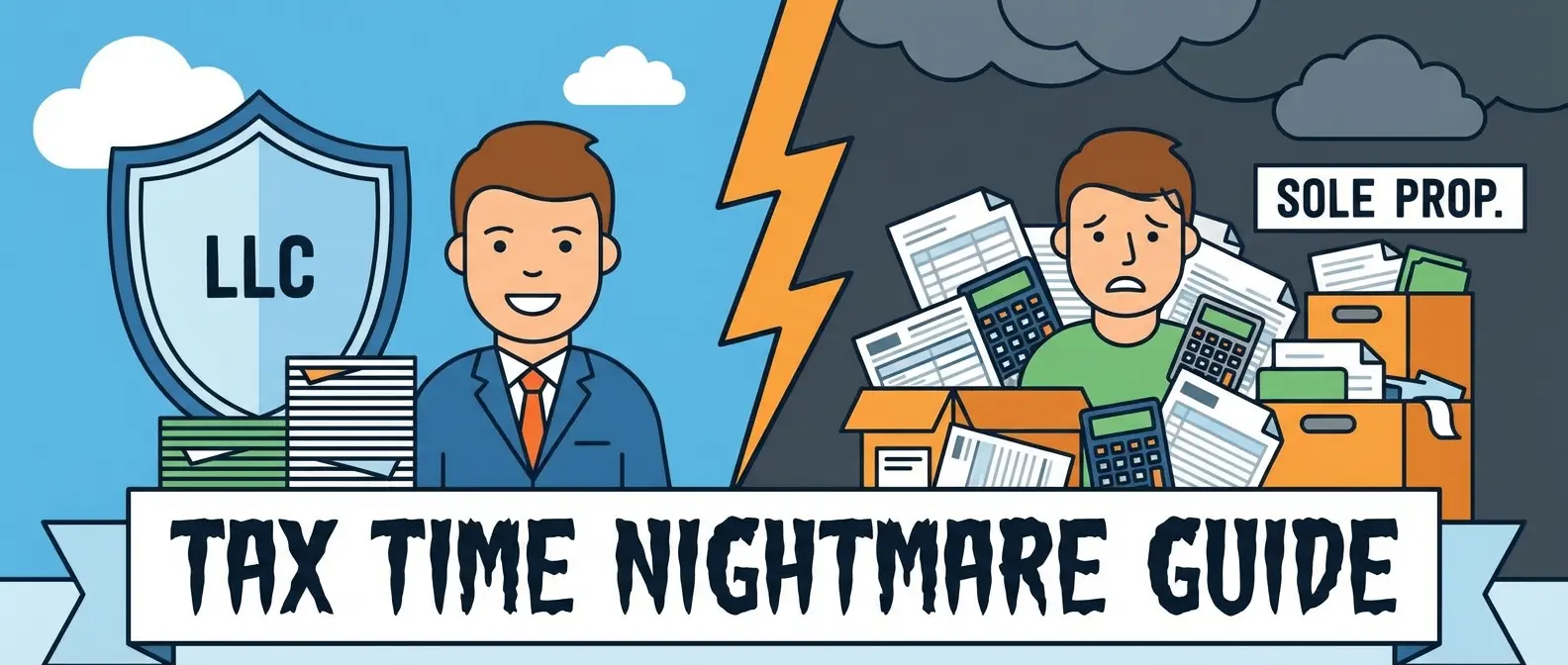
LLC vs Sole Proprietorship: The Business Structure Choice That’ll Haunt You at Tax Time
Look, I get it. You’re a freelancer crushing it on Upwork or building killer WordPress sites. Last thing you want is some bureaucratic nightmare about business structures. But here’s the deal: choosing between an LLC and sole proprietorship isn’t just paperwork theater. It’s the difference between sleeping soundly and waking up in a cold sweat when a client threatens to sue.
I’ve been freelancing for years, and let me tell you—I started as a sole proprietor because it was easy. Zero paperwork, minimal friction. Then I talked to my accountant after my first decent year, and he looked at me like I’d been coding naked in a public library.
What Even Is a Sole Proprietorship?
A sole proprietorship is what happens when you do absolutely nothing. Seriously. The moment you accept your first freelance payment, congratulations—you’re a sole proprietor. No registration, no fees, no separate entity. You and your business are legally the same person.
That sounds convenient, right? It is. Until it isn’t.
Here’s what sole proprietorship actually means:
- You report all income on your personal tax return (Schedule C)
- All business debts are your personal debts
- If someone sues your business, they’re suing you personally
- Your personal assets—car, house, that embarrassing gaming setup—are all fair game
The only real advantage? It’s dead simple. File your freelance taxes with your regular return, claim business expenses, and call it a day. No separate tax returns, no corporate formalities. You can literally start today.
The LLC: Your Liability Forcefield
An LLC (Limited Liability Company) is like a protective bubble around your personal life. It’s a separate legal entity that stands between you and whatever dumpster fire your client decides to start.
I formed my LLC three years ago after a client threatened legal action because their site went down. (Spoiler: it was their hosting provider, not my code.) Even though I was in the clear, the fact that they could’ve gone after my personal bank account kept me up at night.
Here’s what an LLC gives you:
- Legal separation between you and your business
- Personal asset protection if things go sideways
- More credibility with bigger clients (they trust LLCs more than “Bob’s Freelance Code Shack”)
- Potential tax flexibility (you can choose how you’re taxed)
But it’s not all sunshine and rainbows. Setting up an LLC costs money—usually $50-500 depending on your state. You’ll need to file formation documents, potentially get an EIN, and maintain annual reports. Some states make you pay yearly fees just to exist.
The Tax Situation Nobody Explains Properly
Here’s where it gets interesting. By default, a single-member LLC is taxed exactly like a sole proprietorship. Yeah, you read that right. The IRS treats it as a “disregarded entity,” meaning you still file Schedule C with your personal return.
So why bother? Two words: liability protection.
But here’s the kicker—you can elect to have your LLC taxed as an S-Corp once you’re making real money. This lets you split income between salary and distributions, potentially saving thousands on self-employment taxes. I won’t pretend I understood this immediately. It took my accountant drawing diagrams.
The freelance taxes game changes significantly with an S-Corp election, but that’s another rabbit hole entirely. Don’t even think about it until you’re consistently clearing $60k+.
When You Actually Need an LLC
Not every freelancer needs an LLC. If you’re doing $10k/year building Squarespace sites on the side, the juice probably isn’t worth the squeeze. Stick with sole proprietorship and save yourself the hassle.
But consider forming an LLC if:
- You’re making enough that getting sued would genuinely wreck your life
- You work with enterprise clients who prefer dealing with registered entities
- You’re in a high-risk field (think anything involving user data, accessibility requirements, or compliance)
- You want to scale beyond just yourself and potentially hire contractors
- You’re planning to build something bigger than a one-person operation
I pulled the trigger when I started landing $20k+ projects. At that point, the annual LLC fees felt like cheap insurance compared to the risk exposure.
The Paperwork Reality Check
Let’s talk about what nobody mentions: the ongoing maintenance. A sole proprietorship requires nothing. An LLC? You’ve got annual reports, registered agent requirements, separate bank accounts, and proper bookkeeping.
I’ll be honest—the first year I had an LLC, I almost missed my annual report deadline. Would’ve cost me $500 in penalties and potentially lost my good standing. Set calendar reminders. Seriously.
You’ll also need to maintain that “corporate veil” everyone talks about. This means:
- Keep business and personal finances completely separate
- Don’t use business accounts for personal expenses (yes, I’ve been tempted)
- Sign contracts in your LLC’s name, not your personal name
- Actually treat it like a separate business entity
If you blur these lines, a court can “pierce the corporate veil” and suddenly your liability protection evaporates. It’s called building with duct tape, but for legal structures.
What About Multiple LLCs?
Some freelancers create separate LLCs for different ventures. I have one friend who runs three: one for client services, one for his SaaS product, and one for affiliate marketing income.
Is this overkill? Maybe. But if one business carries significantly more risk than another, it might make sense. The downside is multiplying your annual fees and paperwork by however many entities you create.
For most digital freelancers, one LLC is plenty. Don’t overcomplicate your life unless there’s a legitimate reason.
My Actual Recommendation
Start as a sole proprietor. Get your first few clients, figure out if freelancing is actually sustainable for you, and don’t stress about business structure while you’re still figuring out your invoicing process.
Once you’re consistently making $30k+ annually and working with serious clients, form an LLC. The peace of mind is worth the few hundred bucks and minimal paperwork.
And for the love of all that’s holy, talk to an actual accountant in your state. Tax laws vary wildly, and what works in Delaware might be terrible advice in California. I’m just a developer who’s been through this circus—not your lawyer or CPA.
The Small Business Structure Decision Tree
Here’s how I think about choosing a business structure:
- Making under $20k/year? Sole proprietorship. Keep it simple.
- $20k-60k and growing? LLC for protection, default tax treatment.
- Over $60k consistently? Talk to a CPA about S-Corp election.
- Building something that’ll need investors someday? Maybe skip straight to a C-Corp (but that’s a different article).
The worst thing you can do is let analysis paralysis stop you from taking clients. I’ve watched developers spend months obsessing over the perfect business structure instead of, you know, actually building businesses.
Insurance: The Thing Everyone Forgets
Quick tangent: whether you choose LLC or sole proprietorship, get professional liability insurance. It’s cheap (I pay like $500/year) and covers things your business structure won’t—like accusations of professional negligence.
An LLC protects your personal assets if your business gets sued. Insurance pays for your legal defense and any settlements. You need both.
I learned this after a project went sideways and the client’s lawyer started making noise. My LLC meant they couldn’t touch my house. My insurance meant I didn’t have to pay $10k in legal fees to defend myself.
Final Thoughts From Someone Who’s Been There
The LLC vs sole proprietorship debate isn’t actually that complicated. It’s basically: “Do I want liability protection and am I willing to do some paperwork to get it?”
I chose yes because I’m paranoid and like sleeping at night. Your mileage may vary.
Just don’t let this decision become another thing on your never-ending list of abandoned ideas. Pick something, move forward, and adjust later if needed. You can always convert from sole proprietorship to LLC. It’s not a marriage—it’s a business decision you can change.
Now stop reading business structure articles and go invoice that client who’s been “reviewing” your work for three weeks.