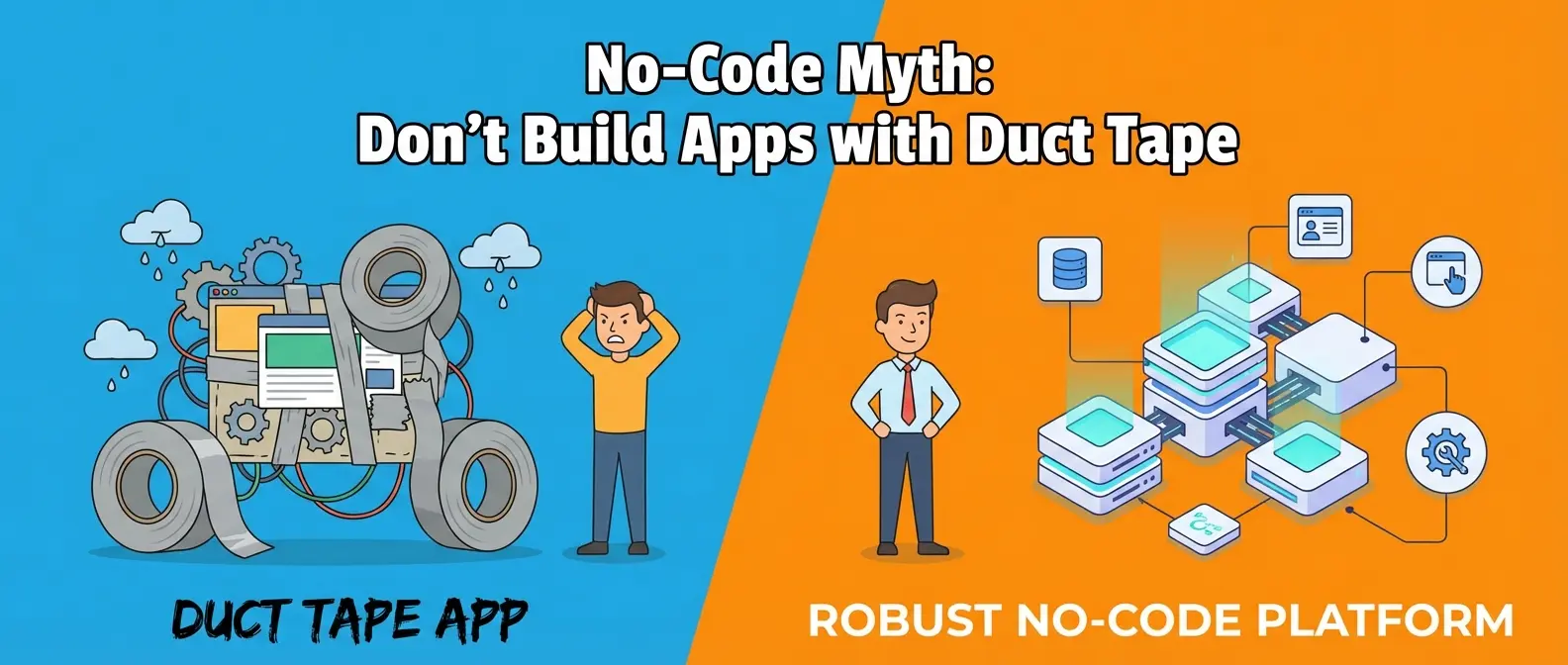
The “No Code” Lie We All Want to Believe
Let’s be honest for a second. We are all tired. The backlog is growing, the PM is asking why the button is the wrong shade of blue, and you’re three espressos deep trying to figure out why a dependency update just nuked your entire staging environment. In this moment of weakness, the siren song of no code platforms sounds pretty sweet. “Build apps without code!” they scream. “Launch in minutes, not months!”
It’s tempting. It feels like cheating. And if you are in startup tech, where speed is the only currency that matters, it feels like a lifeline.
But here is the cynical truth: using a drag-and-drop builder for a complex application is like trying to fix a server crash with a roll of duct tape. It might hold for ten minutes, but eventually, things are going to get messy.
The Honey Trap of Web Builders
Web builders are great. Really. If you need a landing page for your aunt’s cat-grooming business, do not spin up a React app. Please. Just use the builder. These tools have democratized the web, allowing non-technical founders to validate ideas without burning cash on engineering salaries.
However, the marketing hype suggests these platforms are a replacement for actual engineering. They aren’t. They are the instant coffee of the internet. Fast? Yes. Cheap? Absolutely. But if you want the rich complexity of a proper brew, you are going to be disappointed.
The problem arises when you buy into the idea that drag-and-drop can solve every problem. It starts fine. You drag a box here, a button there. But then you need a specific interaction. Maybe you want to implement a trendy aesthetic you saw recently. You try to replicate the clash between Neo-Brutalism and Glassmorphism, and suddenly, the platform says “no.” You are stuck inside their walled garden, banging your head against the constraints of a “flexible” editor that is actually about as flexible as a brick.
Custom Coding: The Pain and the Power
Custom coding hurts. It involves debugging, reading obscure documentation, and questioning your life choices at 2 AM. But it gives you something no code tool ever will: total control.
When you write the code, you own the stack. You aren’t at the mercy of a platform doubling its pricing or deprecating a feature you rely on. You can optimize performance until the site loads faster than a caffeine jitter. You can build architectures that actually scale rather than collapsing under the weight of generated bloatware.
There is a lot of noise right now about how AI and automation are going to make us obsolete. I’ve seen the panic. I’ve had the nightmares where a toaster takes my job. But before you spiral, take an honest look at AI in web development. The robots are good at snippets, but they (and no-code tools) are terrible at understanding the chaotic, human nuance of a large-scale system.
See It In Action
Where the Lines Blur
The debate shouldn’t be binary. It isn’t “code vs. no code.” It is about choosing the right tool so you don’t end up crying in a server closet.
- Use No Code when: You are building a prototype, a marketing site, or an internal tool that only three people will see. It’s perfect for the “MVP” phase where you just need to exist.
- Use Custom Code when: You are building the actual product. If your business logic is your competitive advantage, do not outsource it to a template.
The industry is shifting. The expectations for developers are getting weirder. A few years ago, you had to know everything. We reached peak hype where companies wanted one person to do the job of five. Thankfully, the full-stack unicorn is dead, or at least dying. We are realizing that specialization matters.
The Verdict
If you are a developer, stop sneering at the no-code tools. They handle the boring stuff so you don’t have to. Use them to get the marketing team off your back. But don’t let anyone tell you that custom coding is dead.
As long as clients want weird features, specific performance metrics, or designs that look like a rainbow exploded inside a text factory, there will be a need for someone who knows how to write a `for` loop.
Technology moves fast. One day you are the master of jQuery, the next you are trying to survive web development in 2025 without losing your mind. No code is just another layer of abstraction in a history full of them. Use it, abuse it, but don’t forget how to pop the hood and fix the engine yourself.