Will a Robot Take My Coding Job? An Honest Look at AI in Web Development
I have a recurring nightmare. I’m in a job interview, and the hiring manager is a sleek, chrome toaster with an unnervingly calm voice. It asks me to write a simple JavaScript function, and before I can even type `const`, the toaster has already built, tested, and deployed a full-stack application that solves world hunger. I wake up in a cold sweat. This is the reality of being a developer in the age of artificial intelligence. The fear is real, but is it justified? Are our coding jobs doomed, or is this just the next big evolution in future tech?
Let’s be honest, the panic is understandable. We see AI tools generating entire websites from a single sentence, and it’s easy to imagine our careers going the way of the dodo bird. But after my initial panic subsided (mostly), I’ve come to a different conclusion. Our jobs aren’t disappearing; they’re just getting a massive, weird, and incredibly powerful upgrade.
The Good News: Why AI Still Can’t Do Your Job
For now, AI is like a brilliant intern who has read every textbook but has zero real-world experience. It can churn out code at a terrifying speed, but it often lacks the most crucial human skills:
- Strategic Thinking: AI can build what you tell it to build. It can’t sit down with a client, understand their business goals, and translate a vague idea like “make it pop” into a functional, user-friendly application. That requires empathy, experience, and the ability to read between the lines.
- Creative Problem-Solving: Ever spent three days debugging a problem that turned out to be a single misplaced comma? That frustrating, hair-pulling process is where real learning happens. AI can fix common errors, but it struggles with novel problems that require a creative leap of logic. It follows patterns; it doesn’t invent new ones.
- The “Why”: The most important part of web development isn’t writing code; it’s understanding why you’re writing it. It’s about architecture, scalability, security, and making thousands of micro-decisions that an AI, for all its power, isn’t equipped to handle strategically. To survive, you need a plan, which is why you should learn how to code in 2025 without crying by focusing on these bigger-picture skills.
The Scary Part: What AI Is Getting Frighteningly Good At
Okay, let’s not sugarcoat it. AI is coming for the boring parts of our jobs, and it’s doing it fast. Repetitive tasks, boilerplate code, and simple component creation are all on the chopping block. Need a contact form? An image gallery? A basic landing page? An AI can probably spin that up faster than you can make a cup of coffee.
This is where we see the most significant shift. The days of getting paid to build simple brochure websites are numbered. AI is getting so good at the visual and structural basics that it’s no surprise some are joking they’ll be fired by a laptop in the near future. This will likely hit entry-level jobs the hardest, as many of those roles focus on the exact kind of repetitive coding that AI excels at automating.
Your New Job Title: The AI Supervisor
So if AI is handling the grunt work, what’s left for us? We become the architects, the directors, the quality assurance. Our value shifts from writing code to guiding and validating AI-generated code. The skill is no longer just about knowing the syntax of a language; it’s about knowing how to ask the right questions to get the right output.
We’re moving past the initial hype of complex prompt engineering. As I’ve said before, prompt engineering is dead; the future is about clear, concise communication with our AI tools. You’ll spend less time writing for-loops and more time describing the logic, the user flow, and the business constraints to your AI partner. Imagine building interfaces where this UI has a mind of its own, adapting to users in real-time because you’ve successfully taught an AI the underlying principles of good UX.
Conclusion: Don’t Panic, Just Adapt
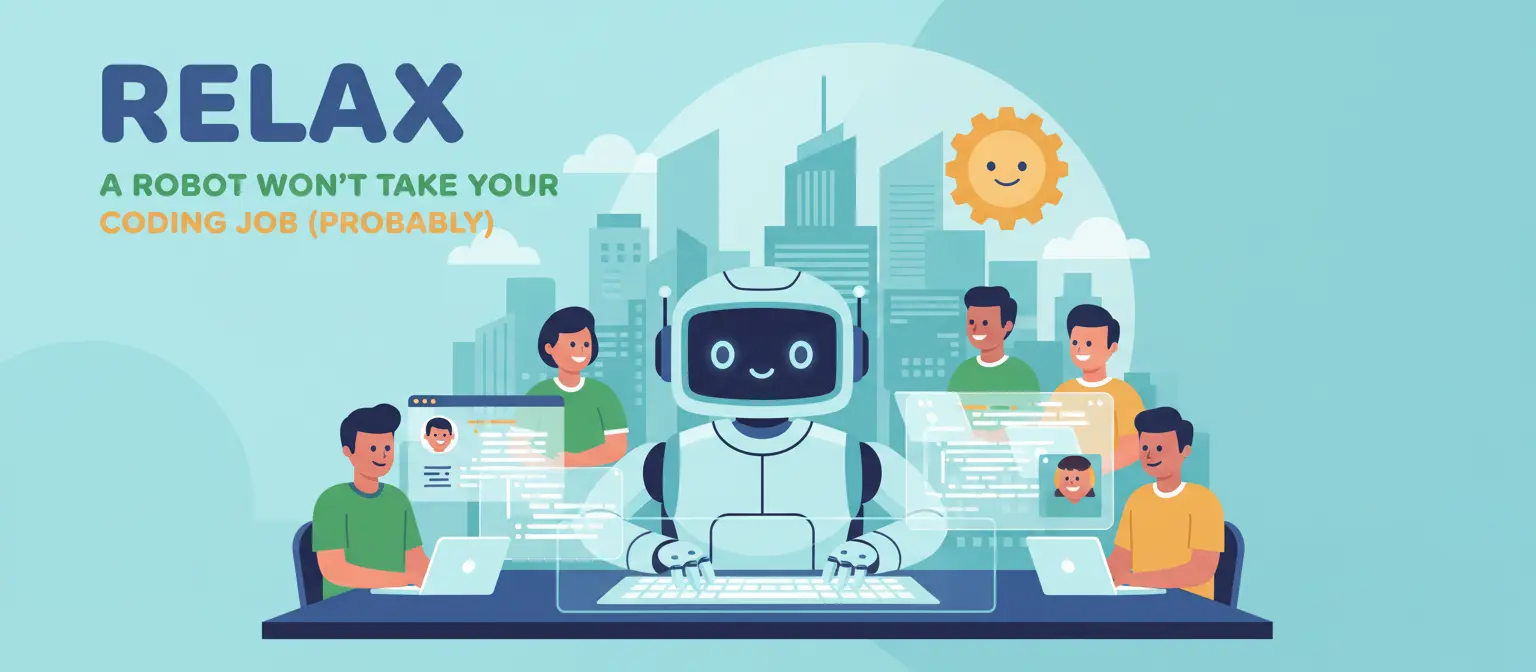
So, will a robot take your job? Probably not. But it will almost certainly change it forever. The future of web development won’t be about man versus machine; it will be about man with machine. The developers who thrive will be the ones who embrace AI as a powerful tool, offloading the tedious work so they can focus on the creative, strategic, and deeply human parts of building for the web.
The barrier to entry for simple projects will get lower, but the ceiling for creating truly innovative and complex applications will get much, much higher. The future is weird, and as we look toward AI designers and web trends for 2026, it’s clear we’re just getting started. So, stop worrying about the toaster. Instead, figure out how to use it to make you a better, faster, and more valuable developer.