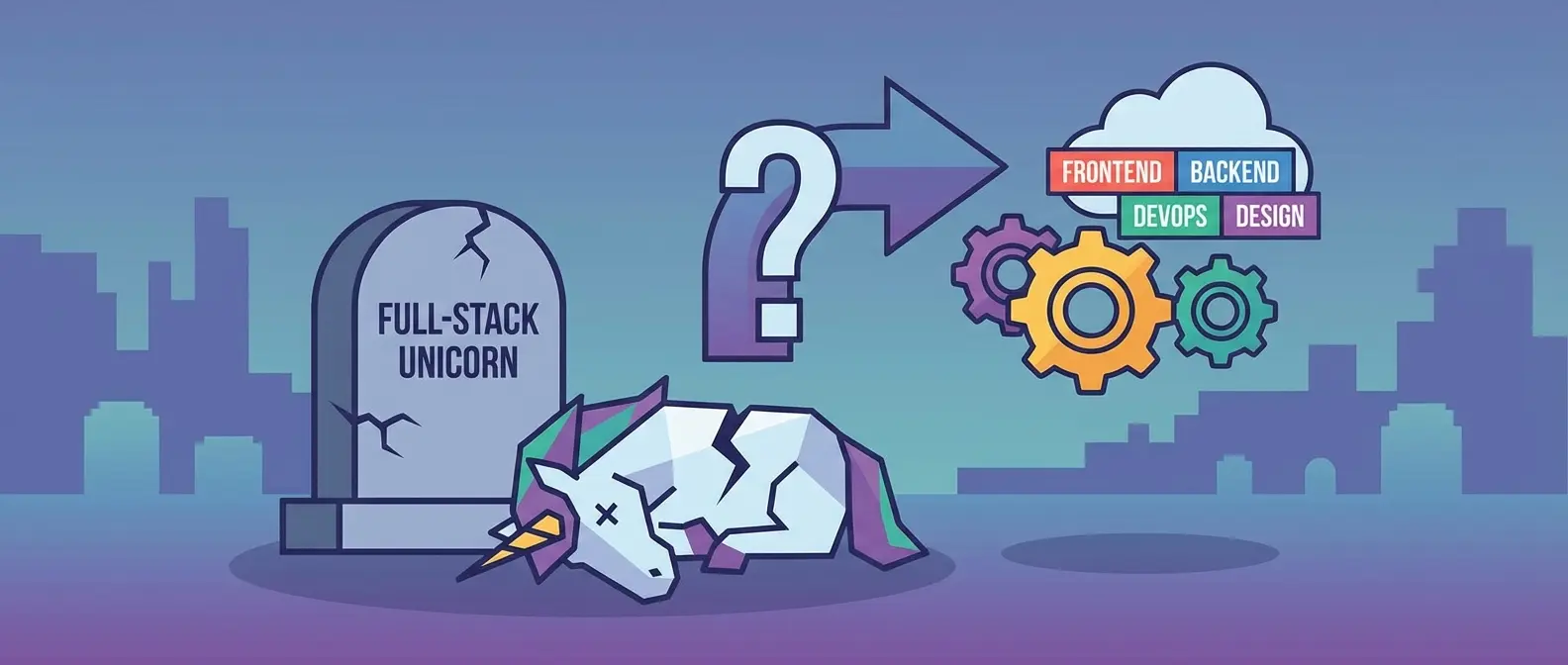
The Rise and Fall of the Full-Stack Unicorn
Remember a few years ago? Every job description was looking for a “Full-Stack Rockstar Ninja.” They wanted someone who could design a flawless UI in Figma, write a performant React front end, build a scalable microservice architecture in Go, configure the Kubernetes cluster to deploy it, and probably also make a decent cup of coffee. It was the ultimate developer ideal: one person who could do it all.
This kind of hype cycle is classic tech. We saw it just recently with the title “Prompt Engineer” flashing across LinkedIn like a supernova before dimming just as quickly. As I wrote in “Prompt Engineering Is Dead. Long Live Prompting!”, the industry loves to invent a superhero title for a specific set of skills. But for the full-stack developer, the cape is starting to feel a little heavy.
When Being a Generalist Was Awesome
Let’s be fair, the full-stack developer wasn’t just hype. In the early days of a startup or a small team, having someone who could jump between the front end and the back end was incredibly valuable. You could build an entire MVP with one or two people. The stack was simpler, too. You had your LAMP stack, your MEAN stack… you could reasonably get your head around the whole thing without your brain leaking out of your ears.
This “jack of all trades” approach allowed for rapid development and iteration. But that was then. This is now.
See It In Action
The Stack is Now a Skyscraper
The tech landscape of today is a sprawling, chaotic, wonderful metropolis compared to the quiet town it used to be. The term “full stack” now covers a dizzying amount of territory. Just look at the explosion in complexity:
- Frontend: It’s not just HTML, CSS, and jQuery anymore. We have component-based frameworks (React, Vue, Svelte), complex state management libraries, server-side rendering, static site generation, and a million build tools. A true frontend expert needs to be obsessed with performance, knowing why your font folder is bloated and when to use Grid vs Flexbox.
- Backend: Are we talking about a monolith or microservices? Are we using REST, GraphQL, or gRPC? What about the database? SQL, NoSQL, or a graph database? Then there are message queues, caching strategies, and authentication protocols.
- DevOps & Cloud: Oh, you also need to be an expert in AWS, GCP, or Azure, right? And you’d better know your way around Docker, Kubernetes, CI/CD pipelines, and infrastructure as code with Terraform.
Expecting one person to be a true expert in all of these areas is unrealistic. When a generalist tries to manage this entire skyscraper, you end up with cracks in the foundation. You get inconsistent user interfaces, what I call a “Frankenstein UI”, because no one is truly owning the user experience. You get unoptimized database queries because the developer was too busy wrestling with Webpack.
The Specialist Strikes Back: A Major Software Engineering Trend
Because of this complexity, we’re seeing one of the most important software engineering trends in years: the return of the specialist. Companies are realizing that a team of experts collaborating is far more effective than a team of generalists spread too thin.
You need a Frontend Engineer who lives and breathes accessibility and performance. You need a Backend Engineer who can design APIs that are a joy to use and can scale to millions of requests. You need a Platform Engineer who geeks out on making deployments seamless and resilient. These roles aren’t just “part of the stack”; they are entire careers.
Your Developer Career Path: Full Stack vs Specialized?
So, what does this mean for your developer career path? Should you abandon the full-stack dream? Not exactly. The debate of full stack vs specialized isn’t about choosing one and forgetting the other. The new ideal is the “T-shaped” developer.
Imagine the letter “T”:
- The horizontal bar represents your broad knowledge across the stack. You should understand how the front end talks to the back end. You should know what a CI/CD pipeline is and why it matters. This context makes you a better collaborator.
- The vertical bar represents your deep, specialized expertise in one or two areas. This is where you bring unique value. This is your “thing.” Maybe you’re the go-to person for React performance, API security, or database optimization.
This T-shaped approach is the key to thriving long-term. Having a specialty makes you invaluable, while having broad knowledge makes you a versatile team player. It’s the most practical advice for anyone wondering how to code in 2025 without crying.
So, let’s retire the “Full-Stack Ninja.” Be a great Frontend Engineer who understands the backend. Be an amazing Cloud Engineer who can read a React component. Find your passion, go deep, and become a specialist. Your team—and your sanity—will thank you for it.