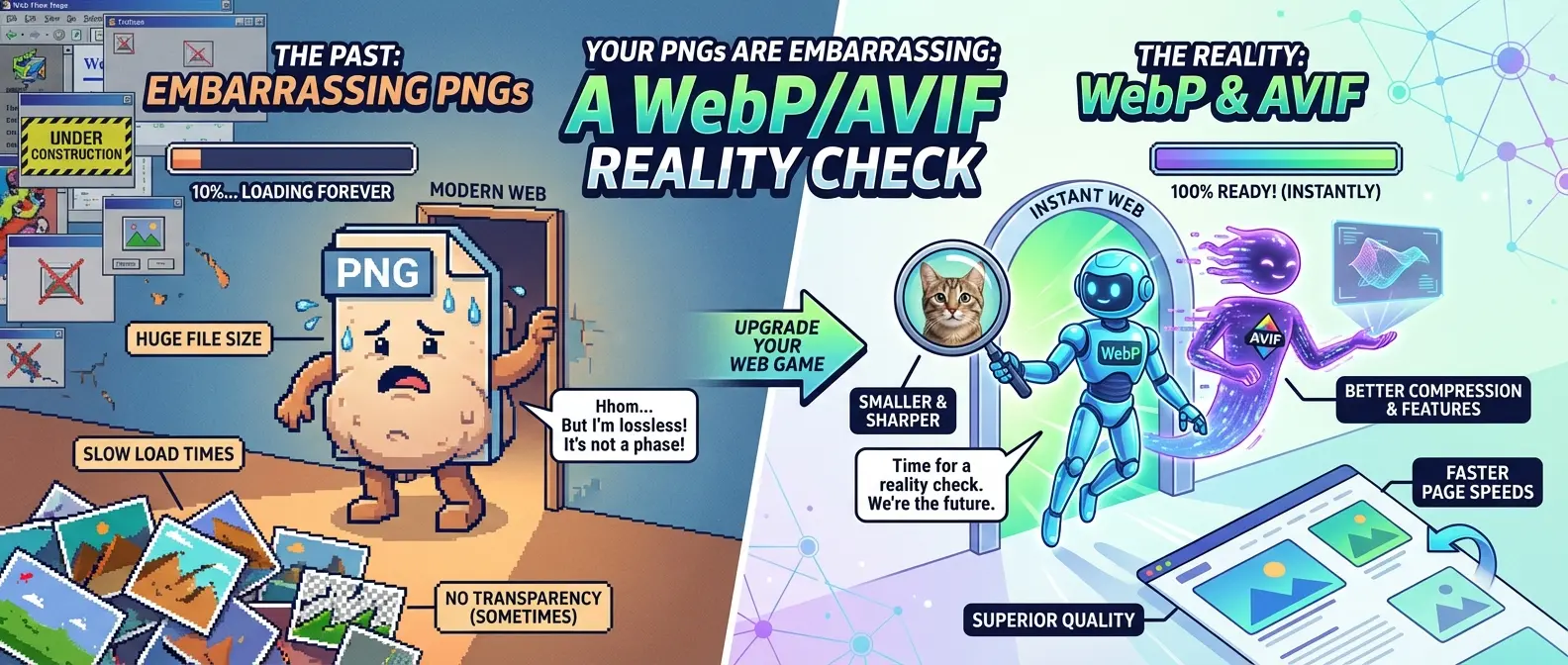
Your Images Are Slow, and We Need to Talk About It
I’m going to say something that might hurt your feelings: those beautiful PNG files you’ve been lovingly uploading to your site? They’re absolute anchors dragging your page speed straight to the bottom of the ocean. And that “high-quality” JPEG you exported at 95%? It’s why your users are staring at loading spinners instead of your actual content.
Image optimization isn’t sexy. I know. Nobody got into web development because they were passionate about compression algorithms. But here’s the uncomfortable reality: images account for roughly half of most websites’ total page weight. Half. That’s not a rounding error you can ignore while you obsess over shaving 2KB off your JavaScript bundle.
The Old Guard: JPEG and PNG Need to Retire
JPEG showed up in 1992. PNG arrived in 1996. For context, that’s the same era when people were using dial-up modems and thinking “information superhighway” was a cool phrase. We’ve been hauling these formats around like digital antiques, and honestly? It’s embarrassing.
Don’t get me wrong. These formats served us well. But clinging to them in 2024 is like insisting on driving a horse-drawn carriage because “it still works.” Sure, technically. But everyone else zoomed past you twenty minutes ago.
Enter WebP: The Middle Child
Google released WebP back in 2010, and the web collectively yawned for about a decade. Then Safari finally decided to support it in 2020, and suddenly everyone acted like it was brand new technology.
WebP delivers roughly 25-35% smaller file sizes than JPEG at comparable quality. That’s not nothing. For a hero image that was 400KB as a JPEG, you’re looking at maybe 280KB as WebP. Multiply that across your entire image library, and your site speed improvements start looking genuinely impressive.
AVIF: The New Hotness
If WebP is the sensible hybrid car, AVIF is the electric sports car that makes your neighbor jealous. Based on the AV1 video codec, AVIF crushes file sizes even further. We’re talking 50% smaller than JPEG in many cases. Sometimes more.
The catch? AVIF encoding is slower. Like, noticeably slower. Your build times will feel it. But for web performance, the tradeoff is usually worth it. Users don’t care that your CI pipeline took an extra 30 seconds. They care that your site loaded fast.
The Technical SEO Angle (Because Google Cares)
Let’s talk about why this matters beyond user experience. Google has been screaming about Core Web Vitals for years now. Largest Contentful Paint specifically measures how quickly your main content loads. Guess what usually triggers LCP? Your hero image. That massive banner at the top of your page.
If you’re serious about technical SEO—and if you want organic traffic, you better be—then image optimization isn’t optional. It’s foundational. A slow site gets buried. Period.
This connects directly to reducing your JavaScript bundle size as another performance lever. You can’t fix one and ignore the other.
How to Actually Make the Switch
Alright, enough theory. Let’s get practical.
Step 1: Audit Your Current Situation
Run your site through PageSpeed Insights or WebPageTest. Look at how much of your total page weight comes from images. If it’s over 40%, you’ve got work to do. If it’s over 60%, stop reading and start converting. Now.
Step 2: Set Up Progressive Enhancement
You can’t just swap everything to AVIF and call it a day. Some browsers—mostly older ones—won’t support it. Here’s the approach that actually works:
- Serve AVIF to browsers that support it (Chrome, Firefox, Safari 16+)
- Fall back to WebP for browsers that support that but not AVIF
- Keep JPEG/PNG as the final fallback for ancient browsers
The HTML picture element handles this beautifully:
The browser picks the first format it understands. Clean. Simple. Works everywhere.
Step 3: Automate or Suffer
You’re not going to manually convert thousands of images. You’ll forget. You’ll get lazy. You’ll upload a raw PNG “just this once” and forget about it forever.
Use a build tool or a CDN that handles conversion automatically. Cloudflare, Imgix, and Cloudinary all offer automatic format negotiation. Your server detects browser support and serves the optimal format without you thinking about it. This is the correct approach if you’re running a headless CMS setup where content editors are uploading images constantly.
Real Numbers From Real Sites
I recently helped migrate a content-heavy site from all-JPEG to WebP/AVIF with fallbacks. Here’s what happened:
- Average image payload dropped from 2.1MB to 890KB per page
- LCP improved from 4.2 seconds to 1.8 seconds
- Bounce rate decreased by 12% over the following month
That’s not magic. That’s just using image formats from this decade instead of the last one.
The Accessibility Connection
Here’s something people forget: faster sites are more accessible. Not everyone has gigabit fiber. Not everyone has the latest iPhone. When you bloat your pages with unoptimized images, you’re essentially telling users on slower connections that they don’t matter.
This ties into treating accessibility as a core quality concern rather than an afterthought. Performance IS accessibility.
Common Excuses (And Why They’re Wrong)
“Our images need to be high quality!”
WebP and AVIF at the right settings look identical to the original. Your users won’t notice any difference. I promise. What they will notice is waiting three seconds for your page to load.
“It’s too complicated to implement.”
A picture element with three source options is not complicated. A CDN with automatic conversion is literally zero extra code. You’re making excuses.
“We’ll get to it later.”
No, you won’t. “Later” is developer-speak for “never.” It’s the same logic as buying domains for side projects you’ll abandon. Rip the bandage off now.
The Bottom Line
Switching to modern image formats is one of the highest-impact, lowest-effort performance wins available to you. It doesn’t require rewriting your application. It doesn’t require learning a new framework. It just requires acknowledging that formats from the Clinton administration maybe aren’t the best choice anymore.
Your site speed will improve. Your technical SEO will benefit. Your users will actually stick around long enough to see your content. And isn’t that kind of the whole point?
Stop babying your PNGs. Convert them. Compress them. Ship faster.