
My Practical Home Coffee Setup: What's Worth It and What to Skip
By Paul Peery · August 2, 2026 · 3 min readUpdated August 13, 2026
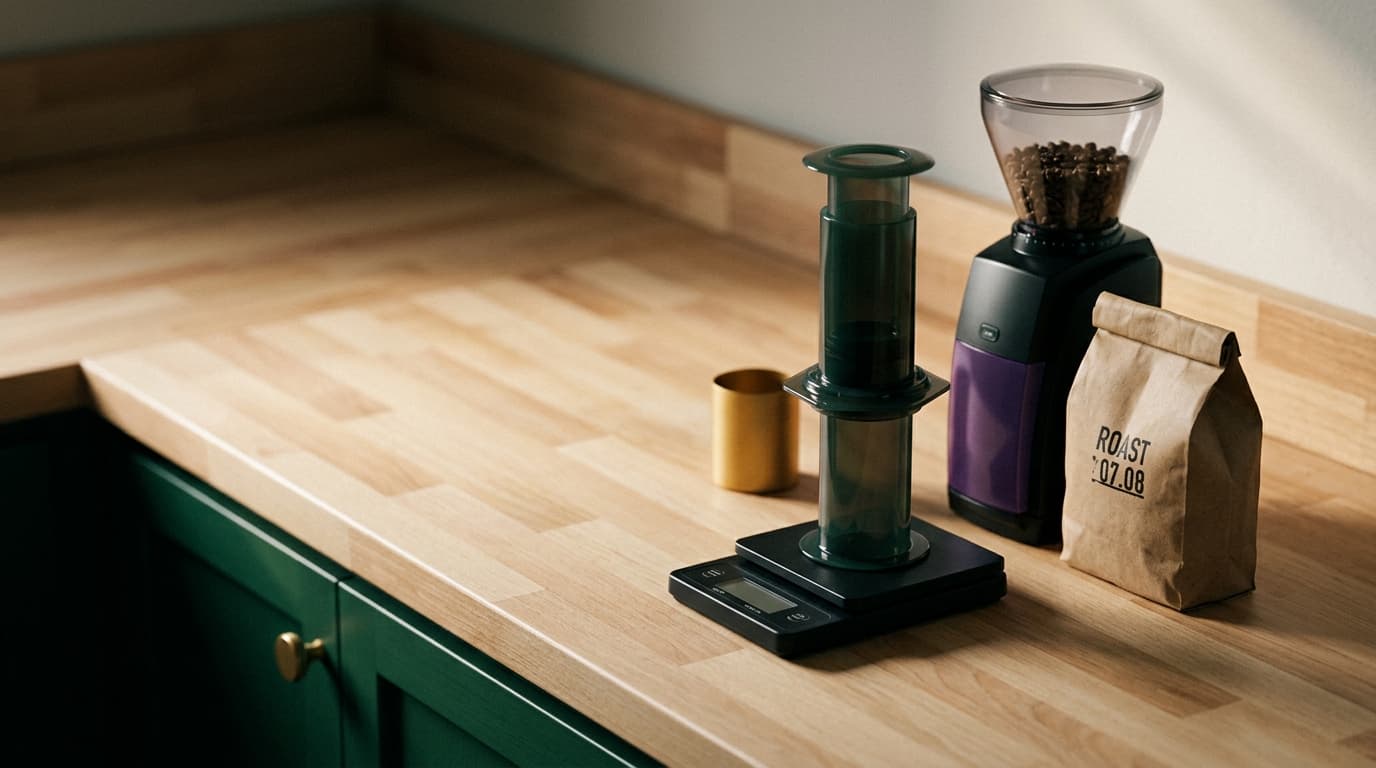
A fancy gooseneck kettle won't fix coffee made from unevenly ground, stale beans. When people want better coffee at home, they usually start by shopping for elaborate pour-over cones or sleek electric kettles. But brewing great coffee comes down to extraction control, and most flashy accessories don't change how extraction works.
Here is a tour of the exact setup I rely on every morning, along with honest notes on where to put your money and what you can safely ignore.
The burr grinder does 80% of the heavy lifting
If you only upgrade one piece of gear in your kitchen, make it a burr grinder. Blade grinders don't actually grind coffee; they smash beans into an unpredictable mix of fine dust and large chunks. That dust over-extracts and turns bitter, while the big chunks under-extract and taste sour.
Conical burr grinders crush beans between two rotating surfaces to a uniform size. That consistency is what lets you extract sweet, balanced flavor. Entry-level electric burr grinders give you that uniformity with forty different grind settings so you can switch from fine drip to coarse cold brew with a quick turn of the hopper.
The trade-off is noise and static. Cheaper electric grinders build up static electricity that sends chaff flying across your counter, and their high-pitch motors aren't quiet at six in the morning. A quality manual hand grinder solves the static problem for less money, but you pay for it in ninety seconds of arm fatigue before your first cup. Prices vary depending on sales, so check current pricing before picking between electric or manual.
Simple immersion brewers beat delicate glass rigs
Pour-over drippers demand precision. If your water flow wanders or your pour technique is off, your cup tastes flat. That level of concentration is fine for a slow weekend, but it is a drag on a busy weekday morning.
Immersion brewers like the AeroPress or a French press are far more forgiving. You mix ground coffee and hot water, let them steep together, and filter out the grounds. Because every coffee particle sits in water for the exact same amount of time, you get a rich, repeatable cup even if you get distracted by an email while pouring.
An AeroPress is nearly indestructible, cleans up in five seconds, and takes up minimal counter space. During hot summer months, I shift away from hot brewing altogether and rely on my cheap no-fuss cold brew method using basic glass jars and standard kitchen tools.
Local roast dates matter more than fancy brand names
No amount of precision gear can save old beans. Coffee starts losing its subtle flavor compounds roughly two to three weeks after roasting. Grocery store bags that list a "best by" date instead of a "roasted on" date could easily have sat on a distribution shelf for four months.
Look for a local coffee roaster that prints an exact roast date directly on the bag. You do not need to sign up for expensive monthly subscription boxes or pay top-tier specialty premiums to get great coffee. Buying fresh medium-roast whole beans from a local spot near you almost always delivers better flavor than imported bags that spent weeks in transit.
What I would skip if I started over today
If I wiped my kitchen counter clean and started from scratch, I would buy less gear, not more. Here is what I would leave out:
- Smart water kettles: A standard stove kettle or a basic fast-boiling electric kettle gets water hot enough. You do not need app connectivity or degree-by-degree digital holds.
- Bluetooth kitchen scales: You do need a scale to measure coffee and water, but a simple fifteen-dollar digital food scale with a tare button works just as well as a hundred-dollar smart scale.
- Single-serve pod machines: The ongoing pod costs add up quickly, the stale pre-ground coffee tastes weak, and the plastic waste builds up fast.
- Pre-ground specialty coffee: Even expensive specialty beans lose most of their aromatic flavor within twenty minutes of being ground.
The one-paragraph buying guide
If you want great coffee without wasting money, buy a basic entry-level conical burr grinder first. Pair it with a durable immersion brewer like an AeroPress, grab a simple digital food scale, and buy whole beans with a recent roast date stamped on the bag. Skip the high-tech kettles and Bluetooth gadgets until you have dialed in those three core pieces.
Keep reading
All posts
Good Espresso at Home Doesn't Require a Four-Figure Machine
You don't need a $2,000 espresso machine to make great coffee at home. Here is the budget gear that punches above its weight, the upgrade that actually matters, and what to skip.
August 8, 2026 · 4 min read