
The Honest Economics and Tech Stack for a Newsletter in 2026
Part of Making Money From a Small Site
By Paul Peery · August 25, 2026 · 4 min read
This post contains affiliate links. If you buy through one, I may earn a commission at no extra cost to you. Full disclosure
You do not have a media business just because you set up a landing page and promised a weekly dispatch. The internet is full of screenshots showing five-figure monthly recurring revenue from paid newsletters, but almost nobody talks about the underlying funnel math: how many readers actually open, how few ever pull out a credit card, and how platform fee structures quietly eat your margins as you grow.
If you want to start a newsletter that makes money without burning out after six months, you need to understand the unit economics before picking your software.
The conversion funnel is smaller than you think
The standard benchmark for converting free newsletter readers into paid subscribers sits between 1% and 2% across general topics, with specialized B2B or financial publications occasionally touching 3% to 4%. For broad lifestyle, general opinion, or personal essay dispatches, the median conversion rate often hovers well below 1%.
To see what that means in practice:
- 1,000 free subscribers typically yields 10 to 20 paying members.
- At a standard $8 to $10 monthly subscription price, that generates $80 to $200 per month in gross billing before platform fees and payment processing.
- A 40% to 45% open rate means roughly 400 people are actually reading any given issue.
On top of that, churn is relentless. Paid consumer newsletters frequently experience 3% to 6% monthly churn from expired credit cards, budget cuts, and inbox fatigue. If you have 100 paying subscribers, you need to add three to six new paid subscribers every month just to stay flat. Treating a newsletter like passive income is a fast way to get frustrated.
Direct sponsorships require real scale or intense niche focus
Selling ads is the other major monetization route, but the math here is equally grounded in raw numbers. Newsletter advertising trades on CPM (cost per mille, or cost per thousand opens, sometimes per thousand delivered emails).
Standard sponsorship rates typically range from $20 to $50 CPM for general audiences, reaching $75 to $100+ CPM for verified corporate buyers, software developers, or financial professionals. If you have 3,000 subscribers with a 40% open rate (1,200 opens), a single sponsorship slot at a $40 CPM yields $48 per issue.
Unless you run a high-ticket, highly targeted niche list, direct ad sales rarely pay meaningful rent until you cross 5,000 to 10,000 active, highly engaged subscribers. Just as with display ads on small websites, rushing to sell cheap sponsor links to a list of 400 people annoys your early champions for pocket change.
The tech stack: where Substack, Beehiiv, and Buttondown actually fit
Your publishing tool determines whether your biggest ongoing cost is fixed software subscription fees or a percentage take of your top-line revenue. Platforms adjust their exact tier features frequently, so check current pricing before committing.
Substack: zero upfront cost, expensive at scale
Substack charges $0 per month upfront and takes a 10% cut of your gross subscription revenue, on top of standard Stripe payment processing fees (roughly 2.9% + $0.30 per transaction plus billing fees).
- The advantage: You pay nothing until you earn money, and Substack’s recommendation network and Notes ecosystem drive genuine discovery for writers without an existing audience.
- The catch: If you earn $3,000 a month, Substack takes $300 every single month just for hosting and sending. That is significantly more than dedicated software costs at that volume.
Beehiiv: built-in monetization tools on a SaaS tier model
Beehiiv operates on a flat monthly software tier. The free Launch tier supports up to 2,500 subscribers with basic features. Paid plans (Scale and Max) start around $43 to $109 per month depending on billing cadence, scaling upward as your subscriber count climbs.
- The advantage: Beehiiv takes a 0% cut on your paid subscription revenue. It also includes an integrated ad network and built-in sponsor tools that let smaller creators run programmatic sponsorships without cold-emailing brands.
- The trade-off: If your list is small and unmonetized, paying a monthly software subscription is an ongoing out-of-pocket expense before you break even.
Buttondown: minimalist, Markdown-first, developer-friendly
Buttondown focuses on clean Markdown writing, strong API access, and strict data privacy. It offers a free tier for up to 100 subscribers, with paid plans starting around $9 to $29 per month depending on automation needs and subscriber size.
- The advantage: It takes 0% platform fees on paid subscriptions through Stripe and provides one of the cleanest developer APIs in the email space.
- The trade-off: There is no built-in discovery feed or ad marketplace. You have to bring your own audience entirely.
Custom setup: total control with zero handholding
For developers building custom web properties, you can wire a subscription form directly to a transactional email API like Resend or Amazon SES paired with Stripe Checkout. This keeps delivery costs down to pennies per thousand emails.
I run custom infrastructure across my own projects, as detailed in my annual software stack breakdown. The trade-off is clear: you are entirely responsible for handling bounce handling, unsubscribe compliance, list hygiene, and configuring SPF, DKIM, and DMARC records yourself. If you just want to write on Tuesday mornings, building custom email pipes is usually an unnecessary distraction.
What I would do if starting today
If you are launching a newsletter with zero audience and want to test whether people care about your ideas, start on Substack or Beehiiv's free tier. Do not pay $50 a month for email software when you have 48 subscribers.
Once your paid subscription income crosses roughly $400 to $500 a month, the 10% platform cut on Substack starts exceeding the fixed monthly cost of a tool like Beehiiv or Buttondown. That is the natural moment to export your CSV list and move to a fixed-tier setup where you keep 100% of your subscription revenue.
Keep reading
All posts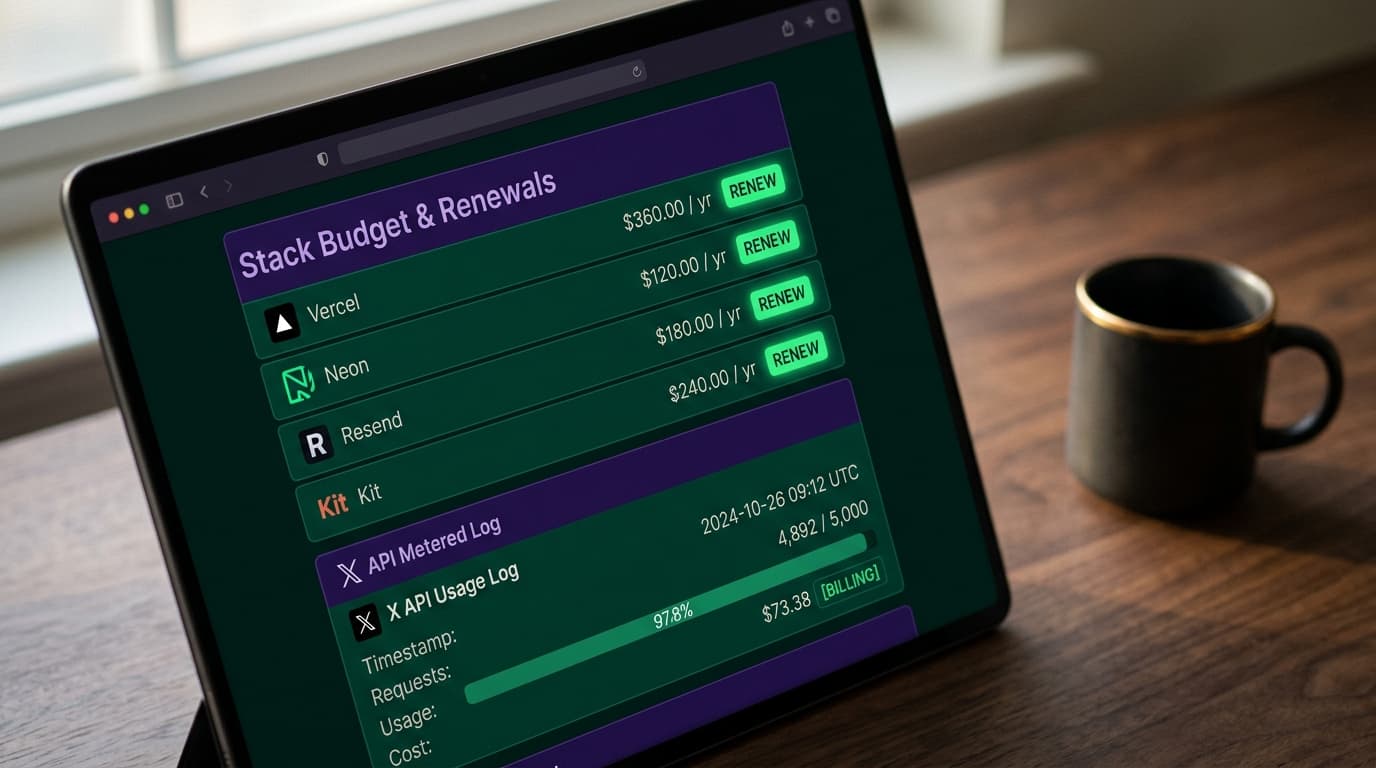
What I Actually Pay to Run a One-Person Web Business in 2026
Subscription creep is death by individually defensible decisions. Here's every line on my software budget—hosting, database, email, newsletter, AI—what each one earns, a would-I-renew verdict on each, and the subscriptions I refused to start.
August 8, 2026 · 6 min read