
Selling cash-secured puts: mechanics, collateral, and assignment reality
Part of Options Trading, From the Beginning
By Paul Peery · October 1, 2026 · 4 min read
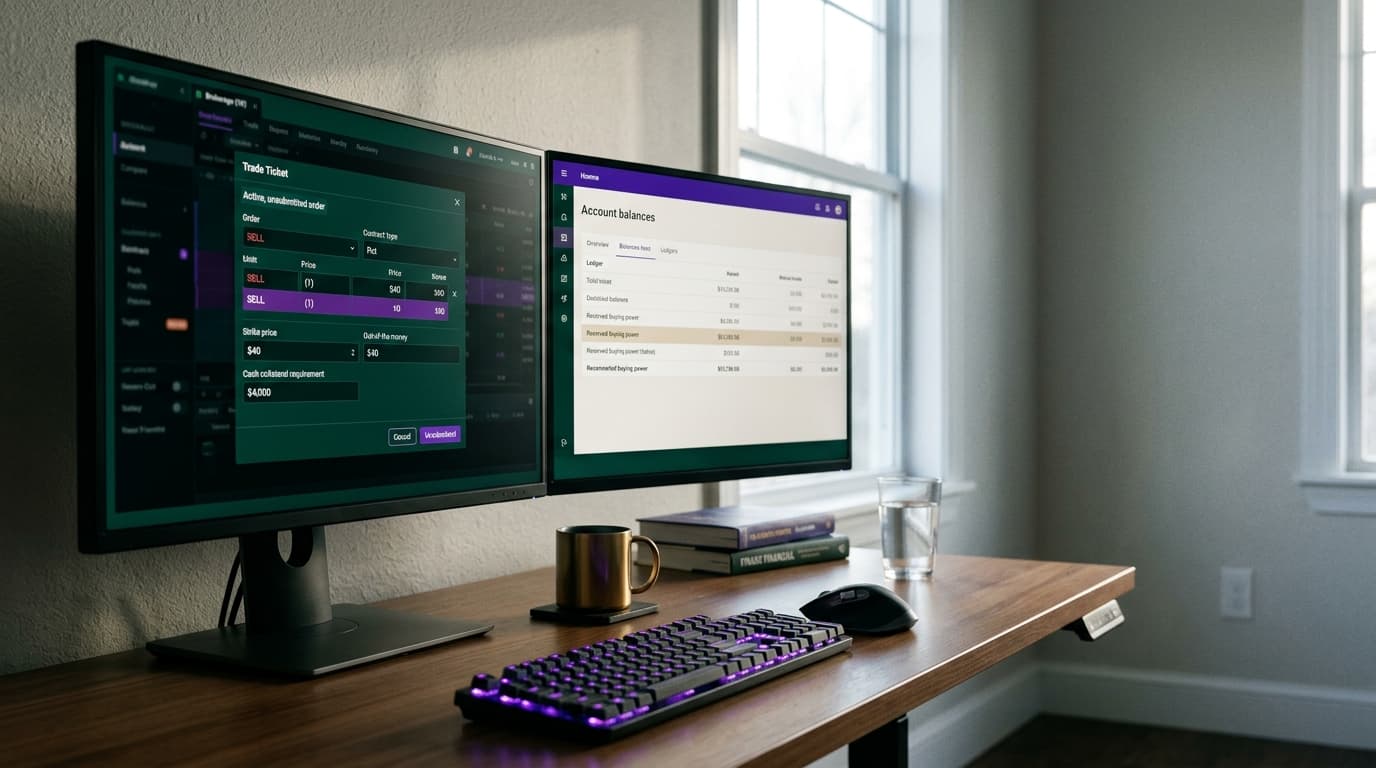
The most misleading pitch in retail options trading is that writing a cash-secured put gives you free money to buy a stock you wanted anyway. That framing treats option premium like a coupon and ignores what the contract actually demands from your account. When you write a put, you take on legal downside exposure to 100 shares of stock while capping your upside to the cash premium you collect on day one.
This walkthrough breaks down the exact mechanics, how brokers handle your cash collateral, and the true cost of assignment when a trade turns against you.
A mandatory reminder before looking at mechanics: this article is strictly educational and does not constitute financial advice. Options involve substantial risk and are not suitable for every investor.
The trade-off starts with 100-share blocks
Every equity option contract covers 100 shares of stock. When you sell a put, you sell someone else the legal right to force you to buy 100 shares at your chosen strike price on or before the contract expiration date.
If you sell one put contract with a $40 strike price expiring in 30 days for a $1.20 premium, the numbers look like this:
- You collect $120 immediately ($1.20 multiplied by 100 shares), minus any exchange and broker contract fees.
- You promise to buy 100 shares at $40 each if the option buyer decides to exercise.
- Your net breakeven if assigned is $38.80 per share ($40 strike minus the $1.20 premium collected).
If the stock stays at $41 through expiration, the contract expires worthless. You keep the $120 and hold zero shares. If the stock drops to $35, you must still pay $40 per share ($4,000 total), even though the open market values those shares at only $3,500. For an introduction to these trade mechanics, review our earlier guide to cash-secured puts.
Broker collateral locks your purchasing power
Brokers do not let you sell a cash-secured put on good intentions. To guarantee you can buy the shares if assigned, your broker places an immediate hold on the full cash value of the strike price.
For a $40 strike put, your broker reserves exactly $4,000 of cash in your account ($40 strike multiplied by 100 shares). That money stays earmarked as collateral for the life of the position. You cannot use it to buy other equities, withdraw it to your checking account, or use it to back other options trades. This capital lockup creates a real opportunity cost, which is why prudent options position sizing rules matter before opening new contracts.
Where that collateral sits depends on your broker. Some brokers keep your collateral in a core money market fund that continues accruing interest while the hold is active. Other platforms sweep collateralized funds into non-interest-bearing holding buckets. Check your brokerage cash-sweep rules to verify whether your locked capital continues earning yield while securing open contracts.
Strike selection determines probability and premium
Choosing a strike price requires balancing immediate income against the likelihood of forced purchase. Most beginners begin by comparing out-of-the-money strikes using option Delta as a rough proxy for assignment probability.
A put option with a 0.20 Delta indicates roughly an 80% statistical chance of expiring out of the money based on current implied volatility. Selling a put deeper out of the money offers a larger safety buffer below current market prices, but yields a smaller dollar premium. Conversely, selling an at-the-money put generates substantial premium while leaving you vulnerable to assignment on minor downward price moves. We cover the math behind these strike trade-offs in our guide on picking strike prices using delta.
Targeting expiration windows between 30 and 45 days is common because theta decay accelerates during this window. That time decay erodes extrinsic value faster, allowing option sellers to buy back contracts at a lower price to close the trade before expiration.
Early assignment does not wait for expiration Friday
Standard American-style options allow the contract holder to exercise their rights on any trading day prior to expiration. While exercise typically occurs when contracts expire in the money on Friday afternoon, early assignment remains an ongoing reality.
Early exercise happens most frequently when an option goes deep into the money and loses its remaining time value, or when an upcoming ex-dividend date makes holding the underlying shares more valuable to the contract owner than holding the option contract. If assigned early, your collateral converts into 100 shares overnight without warning. If your long-term plan includes writing calls against those new shares, look into how covered calls function as the second half of this cycle.
A falling price turns paper discounts into real losses
Here is the honesty beat that many options promoters skip: getting assigned on a crashing stock is not a victory. If you sell a $50 put for $2 in premium and the company suffers an earnings miss that drives shares down to $30, you must buy the stock at $50. Your effective basis is $48, but your portfolio takes an immediate $1,800 unrealized loss per contract ($18 per share below your net cost).
A $2 premium does not insulate you from business failure or broad market selloffs. If you would not feel comfortable buying 100 shares outright at the strike price today, writing a put at that strike is an unacceptable risk.
A four-step checklist before placing the order
Before submitting a sell-to-open put order, run through this four-part checklist:
- Confirm you have the full collateral amount (strike price multiplied by 100) sitting in unencumbered cash.
- Review company earnings announcements and ex-dividend dates between your entry day and the contract expiration.
- Calculate your exact downside breakeven (strike price minus per-share premium).
- Verify that you are content holding 100 shares through an extended downturn if the stock crashes below that breakeven point.
Cash-secured puts work as a mechanical, rules-based method to collect yield or acquire shares at predetermined targets, provided you respect the capital lockup and never trade on companies you are unwilling to own.
Keep reading
All posts
Cash-Secured Puts Explained: How to Buy Stocks at a Discount
Selling cash-secured puts lets you collect income while waiting to buy shares at a lower price, but it comes with full downside risk. Here is how the mechanics, collateral, and assignments work.
August 16, 2026 · 5 min read