
Cash-Secured Puts Explained: How to Buy Stocks at a Discount
Part of Options Trading, From the Beginning
By Paul Peery · August 16, 2026 · 5 min read
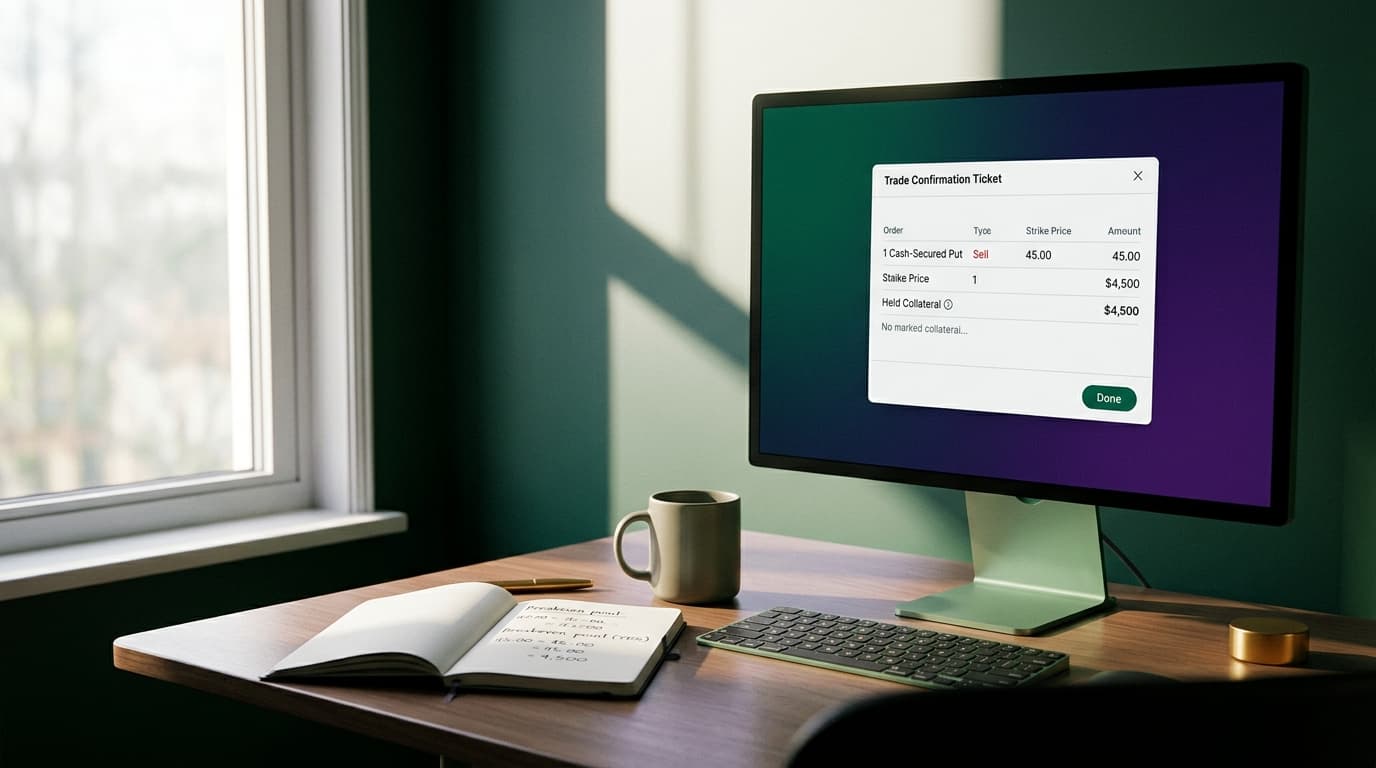
Selling a cash-secured put is often pitched as "getting paid to buy a stock you wanted anyway." That pitch sounds great on paper, but it glosses over the fundamental reality of the trade: you accept almost all the downside risk of stock ownership while capping your upside to the premium collected.
Used with clear expectations, selling cash-secured puts (CSPs) is an effective tool for patient stock buyers. It lets you define an exact entry price on a company you want to hold long-term, collect cash upfront for committing to that price, and lower your effective cost basis. Here is how the mechanics work, how capital gets tied up, and where the strategy can go wrong.
(Standard educational note: This breakdown is strictly for educational purposes and is not financial advice. Options carry risk of loss, and options trading is not suitable for all investors.)
You get paid to set a lower buying price
When you buy a stock through a standard limit order, you tell your broker: "If XYZ drops to $45, buy 100 shares." Your order sits on the order book. If the stock drops, you buy it. If it does not, nothing happens and you make zero dollars for waiting.
Selling a put option formalizes that exact same intention into a legal contract. If you need a refresher on options mechanics, check out my guide on Options Explained for Complete Beginners: Calls, Puts, and Terms.
When you sell an out-of-the-money put, you sell someone else the right to sell you 100 shares of that stock at your chosen strike price before the expiration date. In return for taking on that obligation, the buyer pays you cash upfront—called the premium.
The trade is "cash-secured" because your brokerage requires you to lock up the entire cash amount needed to purchase those 100 shares if assigned. You cannot spend or withdraw that cash collateral while the trade remains open.
Walking through the math and breakeven
Let's look at a concrete example to see how the numbers work in practice.
Suppose stock XYZ currently trades at $50 per share. You like the company, but you think $50 is slightly rich and would prefer to buy in at $45. When you open your broker's options chain, you see a 30-day put contract with a $45 strike price trading for $1.50.
Because one options contract controls 100 shares, here is what happens when you sell to open one contract:
- Premium collected: You receive $150 immediately ($1.50 × 100 shares), which stays in your account regardless of what happens next.
- Collateral required: Your broker sets aside $4,500 in cash ($45 strike × 100 shares) from your buying power.
- Breakeven price: Your net cost per share if assigned is $43.50 ($45.00 strike minus $1.50 premium).
From here, only two fundamental paths exist when expiration day arrives.
If XYZ stays above $45, the option expires worthless. You keep the $150 premium, your $4,500 collateral is released back to your available cash, and you own zero shares.
If XYZ falls below $45, the buyer exercises the option. Your broker uses your $4,500 collateral to purchase 100 shares at $45. Because you kept the $150 upfront, your effective purchase price is $43.50 per share.
Assignment mechanics when expiration arrives
If the stock closes even one penny below your strike price on expiration Friday, your short put is in the money (ITM). The Options Clearing Corporation automatically assigns the contract.
You do not have to manually click a button to buy the shares. Over the weekend, your cash collateral disappears from your balance and 100 shares of stock appear in your portfolio by Monday morning. If you want a deeper look at the exact cutoff times, read What Happens When Options Expire: ITM, Assignment, and Friday Surprises.
Once you own those 100 shares, you can hold them as a long-term investment, or you can begin selling calls against them. Using cash-secured puts to acquire stock and then selling calls on those shares is the foundation of The Wheel Strategy: How I Trade Puts and Calls for Income.
Where cash-secured puts go painfully wrong
Every options strategy has a trade-off, and understanding the failure modes is what keeps you solvent. There are two primary ways a cash-secured put works against you.
First, the stock can drop off a cliff. If you sell a $45 put on XYZ and the company releases a catastrophic earnings report that sends the stock crashing to $28, you are still legally forced to buy 100 shares at $45. Your $1.50 premium softens the blow to $43.50, but you are still sitting on an immediate, heavy unrealized loss of $1,550 per contract. Premium never protects you from a structural breakdown in the business.
Second, you face opportunity cost on massive rallies. If XYZ catches a wave of hype and rockets from $50 to $75 over the month, your profit is capped at the $150 premium you collected. You missed out on $2,500 of stock appreciation because you chose to sell a put instead of buying shares outright.
Because of these realities, sizing is everything. Capping each trade to a sensible slice of your total capital prevents one bad earnings report from wrecking your portfolio. I covered this exact math in How I Size Options Trades So One Loss Can't Blow Up the Account.
A pre-trade checklist for selling puts
Before you hit submit on a short put order, run through this four-part filter:
- Do you actually want to own this company for the long haul? Never sell a put on a speculative ticker just because the premium looks high. If you would not feel comfortable owning the shares during a market dip, do not sell the put.
- Is your collateral genuinely available? Make sure the cash required is money you will not need for bills or emergencies during the trade's duration.
- Is your expiration target between 30 and 45 days out? This window balances daily time decay (theta) against the risk of long-term trend shifts.
- Have you checked for upcoming binary events? Look at the calendar for earnings announcements, FDA rulings, or major economic data that could trigger an outsized gap down.
If the ticker passes those checks, selling a cash-secured put is a disciplined, repeatable way to enter high-conviction positions on your own terms.
Keep reading
All posts
Selling cash-secured puts: mechanics, collateral, and assignment reality
Selling a cash-secured put is often sold as getting paid to buy stock at a discount. Here is how cash collateral works, what early assignment means, and why the downside is real.
October 1, 2026 · 4 min read