
What Happens When Options Expire: ITM, Assignment, and Friday Surprises
Part of Options Trading, From the Beginning and Making Money From a Small Site
By Paul Peery · July 26, 2026 · 4 min readUpdated August 13, 2026
Educational Disclaimer
Note: This article is for educational purposes only and does not constitute financial, investment, or trading advice. Options carry significant risk, including the loss of principal.
On paper, option expiration sounds simple: if your contract is in the money, you get stock; if it is out of the money, it disappears.
When you start trading options—whether you are selling covered calls, buying puts, or trading 0DTE options—the actual settlement mechanics behind the scenes are where beginners get caught off guard. Here is what actually happens on expiration Friday, how automatic exercise works, and why 4:00 PM ET is not the final deadline.
ITM vs. OTM: The Mechanics at Expiration
Every equity option contract represents 100 shares of underlying stock. What happens to that contract at expiration depends on whether it finishes in the money (ITM) or out of the money (OTM).
Out-of-the-Money (OTM)
If an option expires OTM, it has no intrinsic value.
- If you are the buyer: The contract expires worthless. You lose 100% of the premium you paid.
- If you are the seller: You keep the full premium you collected up front. The contract disappears from your account over the weekend, leaving you with no further obligation.
In-the-Money (ITM)
If an option expires ITM by as little as $0.01 based on the official closing price, automatic rules trigger.
- If you are the buyer: The Options Clearing Corporation (OCC) automatically exercises the option for you. If you hold a call, you buy 100 shares at the strike price. If you hold a put, you sell 100 shares at the strike price.
- If you are the seller: You face assignment. You will be required to deliver 100 shares (for a short call) or buy 100 shares (for a short put) at the strike price. When I write about selling covered calls and cash-secured puts, assignment is a core part of the trade design, but unexpected assignment can be a real headache.
The Friday Afternoon Window: 4:00 PM vs. 5:30 PM ET
Many new traders assume everything freezes at 4:00 PM ET when the regular stock market closes. That is not how options expiration works.
While regular trading of options contracts stops at 4:00 PM ET, long option holders actually have until 5:30 PM ET (though many brokers enforce an internal cutoff around 4:30 PM or 5:00 PM ET) to notify their broker if they want to exercise an option or override automatic exercise. This notification is called a Contrary Exercise Advice or a "Do Not Exercise" (DNE) instruction.
Because stock prices can keep moving in after-hours trading between 4:00 PM and 5:30 PM ET, an option that looked out-of-the-money at the bell can suddenly become valuable.
Concrete Example: The Friday After-Hours Surprise
To see why this cutoff window matters, look at how an after-hours price jump impacts both sides of a trade.
Hypothetical Example 1: The Short Call Pin Risk
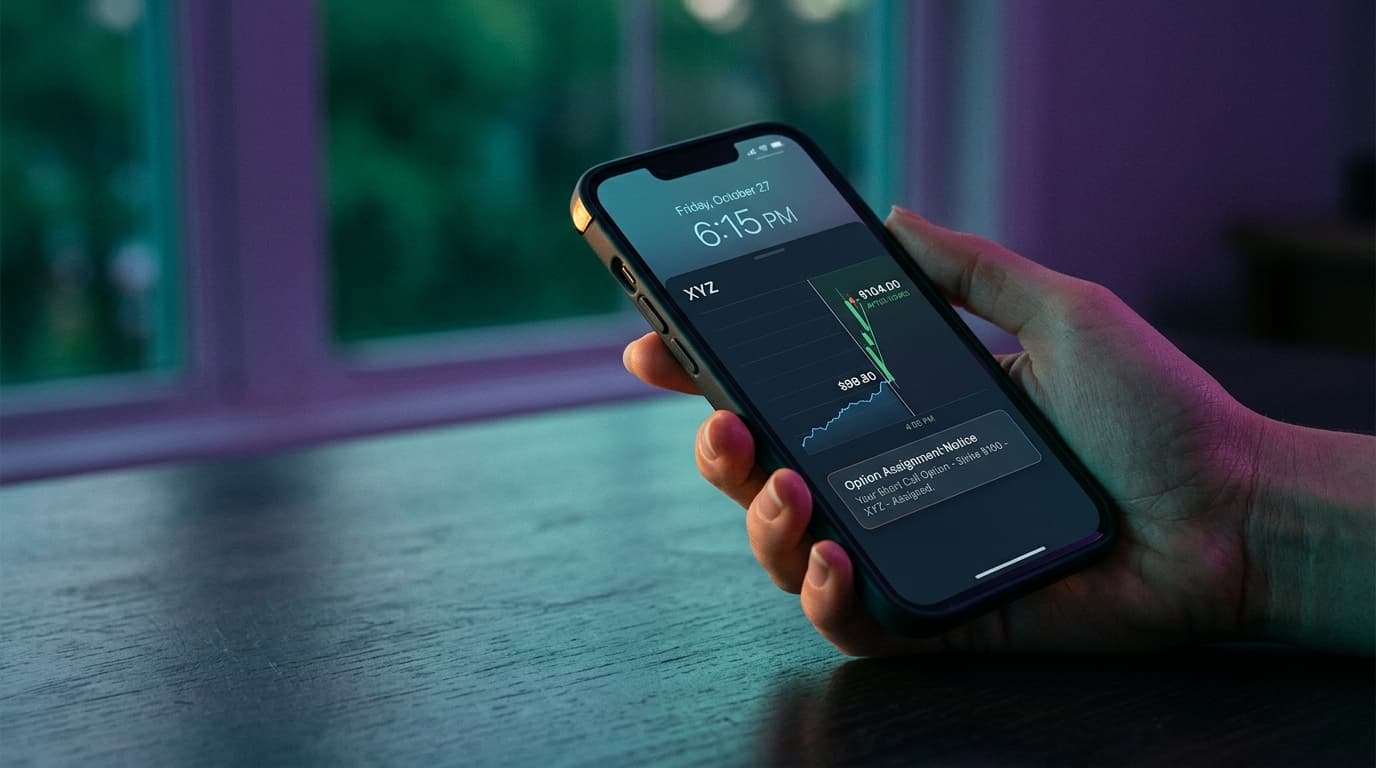
- The Setup: You sell 1 call option on Company XYZ with a $100 strike price expiring Friday.
- 4:00 PM ET Close: Company XYZ finishes regular market trading at $99.80. The call option is $0.20 out of the money. You assume the option expired worthless and close your trading app.
- 4:15 PM ET: Company XYZ releases an unexpected earnings update after hours. The stock jumps to $104.00 in after-hours trading.
- 5:00 PM ET: The person holding the long $100 call sees the stock at $104.00 and submits a Contrary Exercise Advice to their broker before the 5:30 PM deadline.
- Saturday Morning Result: You get assigned on your short call. If you did not own the shares, you wake up Monday morning short 100 shares of XYZ at $100 while the stock trades near $104, leaving you with an unexpected loss or margin call.
This scenario is known as pin risk. When a stock closes right near your strike price, after-hours price moves can trigger unexpected assignments on short positions you thought were dead.
Assignment Mechanics for Sellers
If you sell options—including defined-risk strategies like vertical option spreads—how does assignment actually reach your account?
- The Buyer Decides: Option buyers submit exercise requests or let OCC auto-exercise ITM contracts.
- OCC Random Allocation: The OCC pools all exercise requests and randomly assigns them across clearing brokerages.
- Broker Allocation: Your broker receives their assigned contracts and assigns them to customer accounts using a random draw or a first-in, first-out (FIFO) process.
You cannot choose who gets assigned or predict when it happens over the weekend. By Saturday or Sunday morning, your broker updates your account balances to reflect the share purchase or sale.
The Broker Safeguard: Automatic Liquidation
What happens if your long call option finishes $0.50 in the money, but you only have $500 in cash and cannot afford to buy $10,000 worth of stock?
Brokers monitor expiration risk throughout Friday afternoon. If you hold an ITM long option and your account lacks the capital or margin to absorb 100 shares, your broker will usually step in before 4:00 PM ET. They may issue a "Do Not Exercise" instruction on your behalf or forcibly sell your contract on the open market to lock in cash and protect you from a massive margin call.
How to Avoid Expiration Surprises
If you do not want to hold underlying shares into Monday morning, the best practice is simple: close your open option positions before the bell on expiration day.
Selling to close long options or buying back short options for a few cents eliminates pin risk, clears margin requirements, and lets you enjoy your weekend without waiting for settlement surprises on Monday.
Keep reading
All posts
Selling cash-secured puts: mechanics, collateral, and assignment reality
Selling a cash-secured put is often sold as getting paid to buy stock at a discount. Here is how cash collateral works, what early assignment means, and why the downside is real.
October 1, 2026 · 4 min read