
Options Explained for Complete Beginners: Calls, Puts, and Terms
Part of Options Trading, From the Beginning
By Paul Peery · August 9, 2026 · 4 min readUpdated August 13, 2026
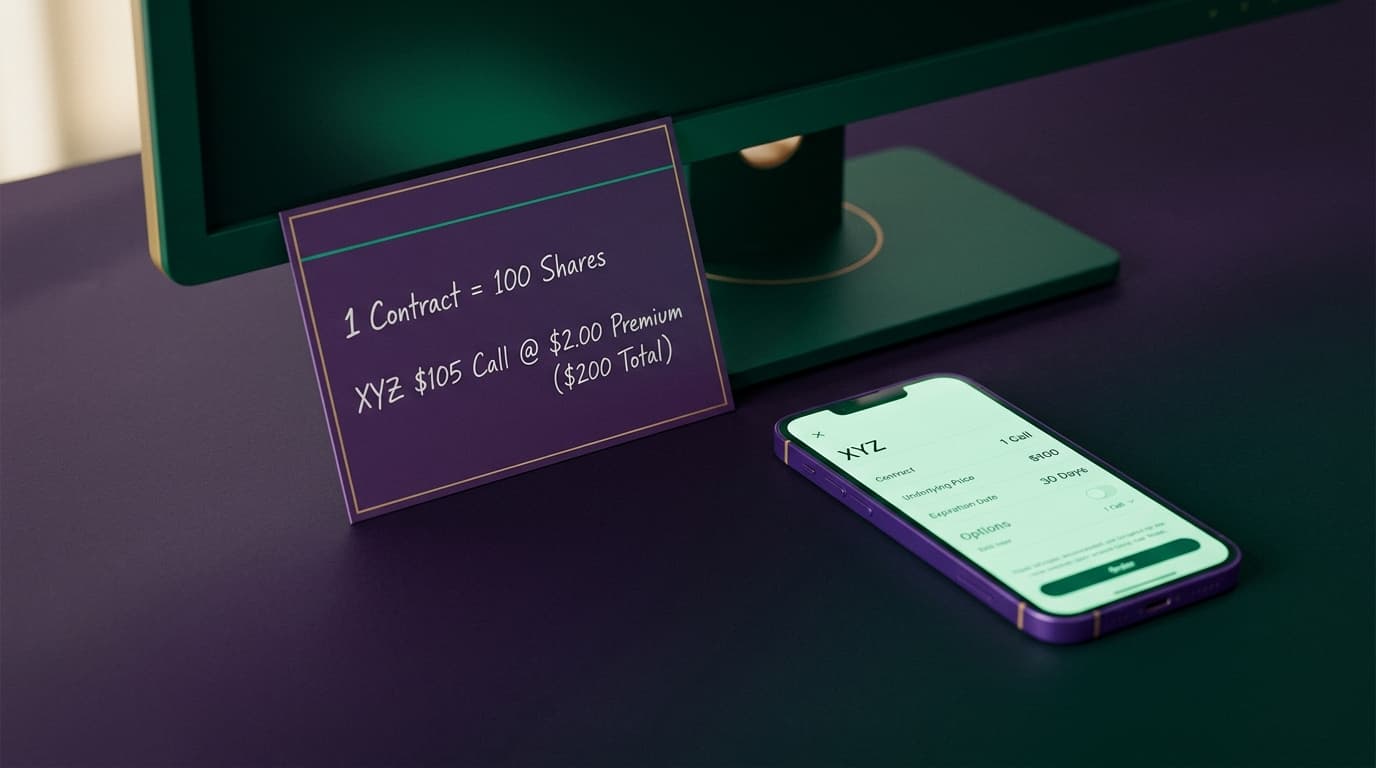
Options sound like high-finance black magic, but they are simply standardized side contracts that let you control 100 shares of stock without owning them outright.
At their core, options are agreements between two parties. One person pays cash today for the right—not the obligation—to buy or sell a specific stock at a set price before a set deadline. Understanding how those pieces fit together is all you need to read an option chain without feeling lost.
Every Contract Comes With Three Fixed Rules
When you look at any option contract, its terms are frozen at the moment it is created. Every contract rests on three core numbers:
- Strike Price: The set price at which you can buy or sell the underlying stock. If a contract has a $100 strike price, $100 is the locked-in transaction price, regardless of where the stock actually trades later.
- Expiration Date: The deadline. Options do not live forever like shares of stock. They expire on a specific date, after which the contract becomes completely void.
- Contract Size: One standard equity option contract in the U.S. controls exactly 100 shares of stock.
The price you pay or receive to trade an option contract is called the premium. Premium is quoted on a per-share basis. So if a broker quotes an option premium at $2.00, buying one contract costs $200 ($2.00 × 100 shares).
Calls Give the Right to Buy, Puts Give the Right to Sell
There are only two basic types of options contracts, but they serve opposite purposes depending on which side of the trade you take:
- Call Option: Gives the buyer the right to buy 100 shares of stock at the strike price before expiration. You buy a call when you expect the stock price to go up.
- Put Option: Gives the buyer the right to sell 100 shares of stock at the strike price before expiration. You buy a put when you expect the stock price to drop, or when you want insurance on stock you already own.
The key distinction is "right, but not the obligation". As an option buyer, you choose whether to exercise the contract. If exercising it would lose you money, you simply let the contract expire worthless. The seller (or writer) of the contract collects your premium upfront, but takes on the legal obligation to fulfill the contract if you choose to exercise it.
A Concrete Walkthrough With Hypothetical Stock XYZ
(Note: This walk-through is purely hypothetical and strictly for educational purposes, not financial advice.)
Imagine hypothetical stock XYZ is trading at $100 per share. You believe XYZ is going to release a great new product next month and rise, but you do not want to spend $10,000 to buy 100 shares outright.
- Buying a Call: You buy one XYZ $105 Call expiring in 30 days for a premium of $2.00 per share ($200 total outlay).
- Scenario A (Stock Rises to $115): Your option gives you the right to buy 100 shares at $105 each, even though they trade at $115 on the open market. The contract itself is now worth at least $10.00 per share ($1,000 total). You can sell the contract back to the market for an $800 profit ($1,000 value minus your $200 initial cost).
- Scenario B (Stock Drops to $95): You would never exercise your right to buy shares at $105 when you can buy them on the open market for $95. You let the contract expire. Your loss is strictly capped at the $200 premium you paid.
This asymmetry—defined downside risk for the buyer with leveraged upside potential—is why traders pay premiums for options.
Why Anyone Trades These Contracts
Investors and traders generally reach for options for three main reasons:
- Speculation: Traders put up a fraction of the capital required to buy 100 shares, seeking a higher percentage return on small stock price moves.
- Hedging (Insurance): Portfolio owners buy puts to protect existing stock holdings against a sudden market drop, creating a guaranteed minimum floor price.
- Income Generation: Share owners sell covered calls or cash-secured puts to collect upfront premium cash flow from stocks they already own or want to buy. I write about this approach in detail in my guide on selling covered calls and puts for income and running the wheel strategy.
Time Decay Is the Trade-Off That Catches Beginners
Here is the honest trade-off that trips up almost every beginner: options lose value every single day just by existing. This continuous loss of value over time is called time decay.
If you buy a share of stock and the price goes sideways for six months, you still own your share. If you buy an option and the stock goes sideways, your option gradually loses value until it expires completely worthless. The market charges you for time. If you predict the stock's direction correctly but get the timing wrong, you can still lose your entire investment.
Because long option positions can fall to zero, position sizing is critical. Before trading real money, learn how sizing options trades prevents a single bad prediction from blowing up your account, and why ultra-short contracts like 0DTE options carry extreme risk for beginners.
The One-Paragraph Beginner Cheat Sheet
If you remember nothing else from this guide, keep these five facts pinned to your desk:
- 1 contract = 100 shares of underlying stock.
- Multiply any quoted option premium by 100 to find your actual dollar cost.
- Calls profit when stock goes up; puts profit when stock goes down.
- Buyers hold rights and cap their risk at the premium paid; sellers take on obligations for upfront cash.
- Time hurts buyers because options expire, so stock moves must happen before deadline.
Keep reading
All posts
How to Read an Options Chain Without Your Eyes Glazing Over
An options chain looks overwhelming at first glance, but you only need a handful of numbers to make a trade decision. Here is how to read the grid, spot liquidity, and filter out the noise.
August 9, 2026 · 5 min read