
Covered Calls for Beginners: Generating Yield on Stocks You Own
Part of Options Trading, From the Beginning
By Paul Peery · August 21, 2026 · 4 min read
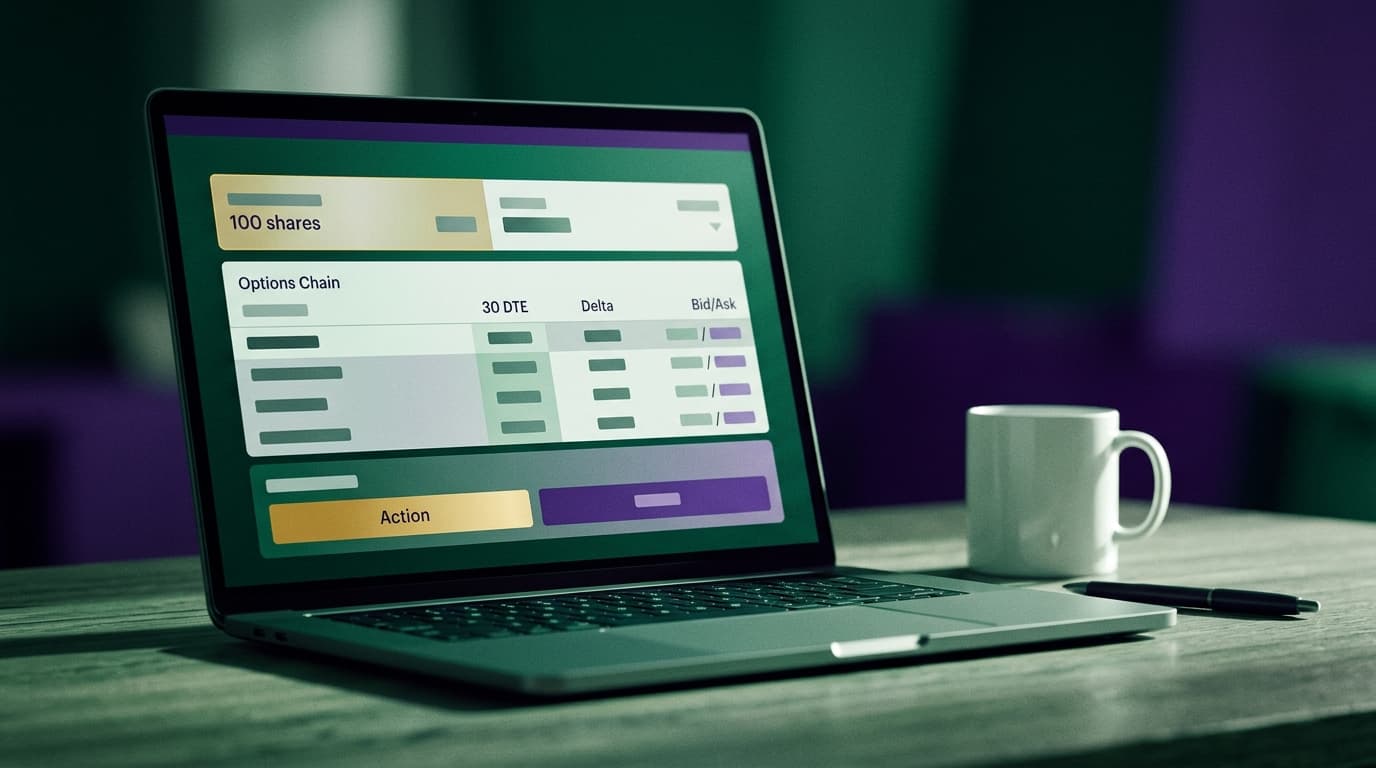
Selling a covered call is not a magic dividend boost or free yield—it is a contract where you sell someone else your potential upside in exchange for immediate cash. If the stock stays flat or moves up gently, you keep the cash and your shares. If the stock moons, your gains stop cold at your chosen strike price while the buyer rides the rest of the wave.
Before jumping in, let's get the standard disclaimer out of the way: this is educational only, not financial advice. Options carry real risk, and selling covered calls will not protect your portfolio from a severe market drop.
The basic mechanics: 100 shares and one contract
To sell a standard covered call, you need to own at least 100 shares of an underlying stock in a standard brokerage account. If you own 100 shares of a company trading at $50, you can sell one call contract against those shares.
When you sell that call, an options buyer pays you an upfront premium directly into your brokerage cash balance. In exchange for that cash, you take on an obligation: if the stock rises above your agreed strike price (say, $55) before the expiration date, the buyer can demand your 100 shares at that exact $55 price, regardless of how high the stock climbs.
If you want a refresher on the foundational vocabulary behind calls, puts, and strikes, check out Options Explained for Complete Beginners: Calls, Puts, and Terms.
Choosing strikes and expiration: the 0.20 to 0.30 delta sweet spot
When you open an option chain, you face dozens of strike prices and expiration dates. I usually look 30 to 45 days out. This window captures the steeper part of time decay (theta) while still offering enough premium to make the trade worth executing.
For strike selection, delta is your quickest compass. While delta technically measures how much an option's price changes per $1 move in the underlying stock, option sellers use it as a rough proxy for the probability of expiring in-the-money:
- 0.15 to 0.20 Delta (Conservative): The strike is far out-of-the-money. You collect a smaller premium, but there is roughly an 80% to 85% statistical probability that the call expires worthless and you keep your shares.
- 0.25 to 0.30 Delta (Balanced): The standard target for income-focused setups. You collect a respectable premium while leaving room for the stock to appreciate 3% to 7% before reaching your strike.
- 0.40 to 0.50 Delta (Aggressive): Near the current share price. You collect maximum cash upfront, but you have a near coin-flip chance of having your shares called away.
If options chains still look like a wall of random numbers to you, walk through How to Read an Options Chain Without Your Eyes Glazing Over to filter down to just the columns that matter.
The honest trade-off: downside risk is still yours
The biggest misconception beginners have is thinking covered calls offer downside protection. They do not.
If you own 100 shares of a $50 stock and sell a $55 call for $1.50 per share ($150 total), that $1.50 gives you exactly $1.50 of downside cushion. If the company misses earnings and the stock falls 30% to $35, your shares lose $1,500 in value while your option premium covers just $150 of the damage. You are still down $1,350 on paper.
A covered call does not stop a falling knife. It only provides a modest yield on stocks you are genuinely comfortable holding through normal market volatility.
What happens at expiration
When the expiration date arrives, one of three things happens:
- The stock finishes below your strike: The call expires worthless. You keep your 100 shares and 100% of the premium collected. You can now sell another call 30 to 45 days out.
- The stock finishes above your strike: Your shares get called away (assigned). You sell your 100 shares at the strike price, keep the cash from the sale plus the original premium, and exit the position. This triggers a taxable capital gains event on the stock, which is worth reviewing in A Beginner's Guide to Stock and Options Taxes.
- The stock runs hard and you want to keep the shares: You can buy back the short call (often at a loss) or roll the contract to a later date and higher strike price for a net credit or debit.
If having your shares called away happens regularly, many traders transition the cash proceeds into selling cash-secured puts to re-enter at a discount, forming the full cycle explained in The Wheel Strategy: How I Trade Puts and Calls for Income.
The one-paragraph rulebook
Only sell covered calls on stocks you want to hold long term, pick strikes at 0.20 to 0.30 delta roughly 30 to 45 days out, and never choose a strike price below what you are happily willing to sell your shares for. If the stock runs past your strike, celebrate the capped profit rather than agonizing over the uncaptured gains.
Keep reading
All posts
How to Sell Covered Calls on Stocks You Own
A plain-language guide to selling covered calls on stock you already own. Learn how strike selection works, the downside trade-off, and what happens when your stock gets called away.
July 30, 2026 · 4 min read