
Understanding Option Greeks: The Only Two Beginners Need to Track
Part of Options Trading, From the Beginning
By Paul Peery · August 27, 2026 · 4 min read

You do not need a degree in financial engineering to trade basic options, but opening your brokerage app makes it feel like you do. Most trading screens blast you with Delta, Gamma, Theta, Vega, and Rho across a massive spreadsheet grid. It is sensory overload, and it causes beginners to freeze up before they place a single trade.
(Standard reminder: Everything here is for educational purposes only and is not financial advice.)
If you are starting out with simple strategies like selling covered calls or buying a long call, you can safely ignore almost the entire Greek alphabet. You only need two metrics to understand what an option contract will do: Delta and Theta.
Delta measures price sensitivity and gives a rough probability
Delta answers the most obvious question: if the underlying stock moves by $1.00, how much will the option's price change?
Delta is expressed as a number between 0 and 1.00 for call options (or 0 and -1.00 for puts). If you buy a call option with a 0.30 Delta on a $100 stock, and that stock rises to $101, your option premium will gain roughly $0.30 per share ($30 for a standard 100-share contract). If the stock falls by $1.00, the option drops by roughly $0.30.
Delta also acts as a fast, practical proxy for market probability. Traders frequently use a 0.30 Delta call as a rough signal that the market assigns about a 30% chance of that option expiring in the money at expiration. A 0.50 Delta option sits right at the current stock price (at-the-money), representing roughly a coin-flip expectation.
Do not treat that probability as an ironclad statistical guarantee. Delta is an output of a pricing formula, not a crystal ball. Market sentiment shifts fast, and unexpected news can blow through strike prices regardless of what the Delta showed when you opened the trade.
When you customize your workspace to read an options chain without clutter, Delta is the first column you want next to your strike prices.
Theta measures the daily cost of holding the contract
Options have an expiration date, which means they lose a sliver of value every day the calendar turns. Theta tells you exactly how much extrinsic value the contract will bleed over the next 24 hours, assuming the stock price and volatility stay unchanged.
Theta is usually displayed as a negative number. If a contract has a Theta of -0.05, that option is losing roughly $5.00 per contract each day to time decay.
Who wins and who loses depends on which side of the trade you take:
- Option buyers fight Theta. When you buy a call or put, time works against you. The stock has to move in your direction fast enough to outpace the daily leak in premium.
- Option sellers collect Theta. When you sell a contract—like when running covered calls on shares you own—time is your direct tailwind. Every quiet day the stock drifts sideways, the contract you sold gets cheaper to buy back.
Theta decay is not a straight line. An option expiring in 90 days loses value slowly. Once a contract enters its final 30 to 45 days, the decay curve bends downward sharply. Option sellers love that steep slope, while long-contract holders get punished by it.
Vega and Gamma can wait until you trade complex spreads
Vega measures how sensitive an option is to changes in market volatility, while Gamma measures how fast Delta itself changes as the stock moves.
Both matter when you manage multi-leg spreads or hold contracts through volatile earnings announcements. As I covered in my breakdown of implied volatility and IV crush, sudden drops in market expectations can gut an option's value even if the stock barely moved.
For a beginner trading 30-to-45-day contracts on stable stocks, Vega and Gamma rarely change your immediate plan. If you know your direction (Delta) and your time horizon (Theta), you already have 90% of the operational picture. Trying to track all four at once leads straight into the beginner options mistakes that wreck accounts.
The honesty check: Greeks are models, not armor
The trap with option Greeks is assuming they predict the future. They do not.
Every Greek is a snapshot calculation derived from theoretical models like Black-Scholes. They assume orderly markets with smooth price changes. When a company misses earnings by 40%, the stock gaps down overnight, liquidity dries up, and bid-ask spreads blow wide open. In those moments, your carefully calculated Delta will not save you from a severe drawdown.
Treat the Greeks as a dashboard speedometer, not an autopilot system.
The two-number routine for your next trade
Before placing any basic options trade, look at just two figures on the chain:
- Check Delta: Use it to pick your strike price. A 0.20 to 0.30 Delta is a common target for conservative option sellers who want distance from the current price. For directional buyers, higher Delta (0.60 to 0.70) reduces the drag of out-of-the-money decay.
- Check Theta: Ask yourself if time decay helps you or hurts you on this trade. If you are buying options, make sure you give yourself enough expiration runway so Theta does not eat your position before the stock has time to move.
Filter out the noise, watch your directional exposure and your daily clock, and leave the rest of the Greek alphabet for later.
Keep reading
All posts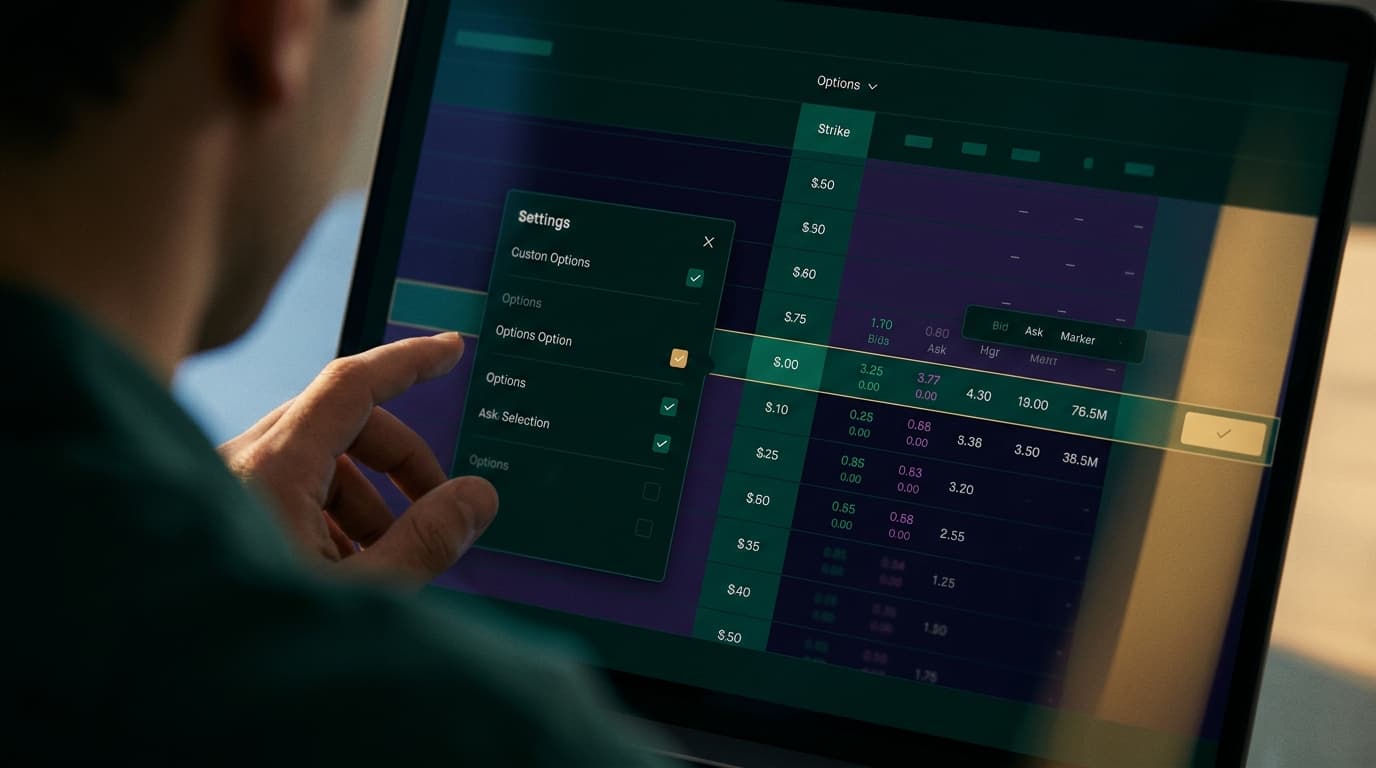
How to Read an Options Chain Without Your Eyes Glazing Over
An options chain looks overwhelming at first glance, but you only need a handful of numbers to make a trade decision. Here is how to read the grid, spot liquidity, and filter out the noise.
August 9, 2026 · 5 min read