
Manual Hand Grinders vs. Budget Electric: Where Coffee Gear Money Matters
By Paul Peery · September 1, 2026 · 5 min read
If you have $80 to spend on a coffee grinder, buying an electric machine guarantees you get worse coffee than buying a manual one.
That sounds counterintuitive until you look at how appliances get built. When a manufacturer sells an electric burr grinder for $60 to $90, that price tag has to cover an AC motor, a reduction gearbox, power switches, safety interlocks, and a molded plastic housing. By the time those parts are paid for, there are only a few dollars left in the bill of materials for the one component that actually touches your coffee: the burrs.
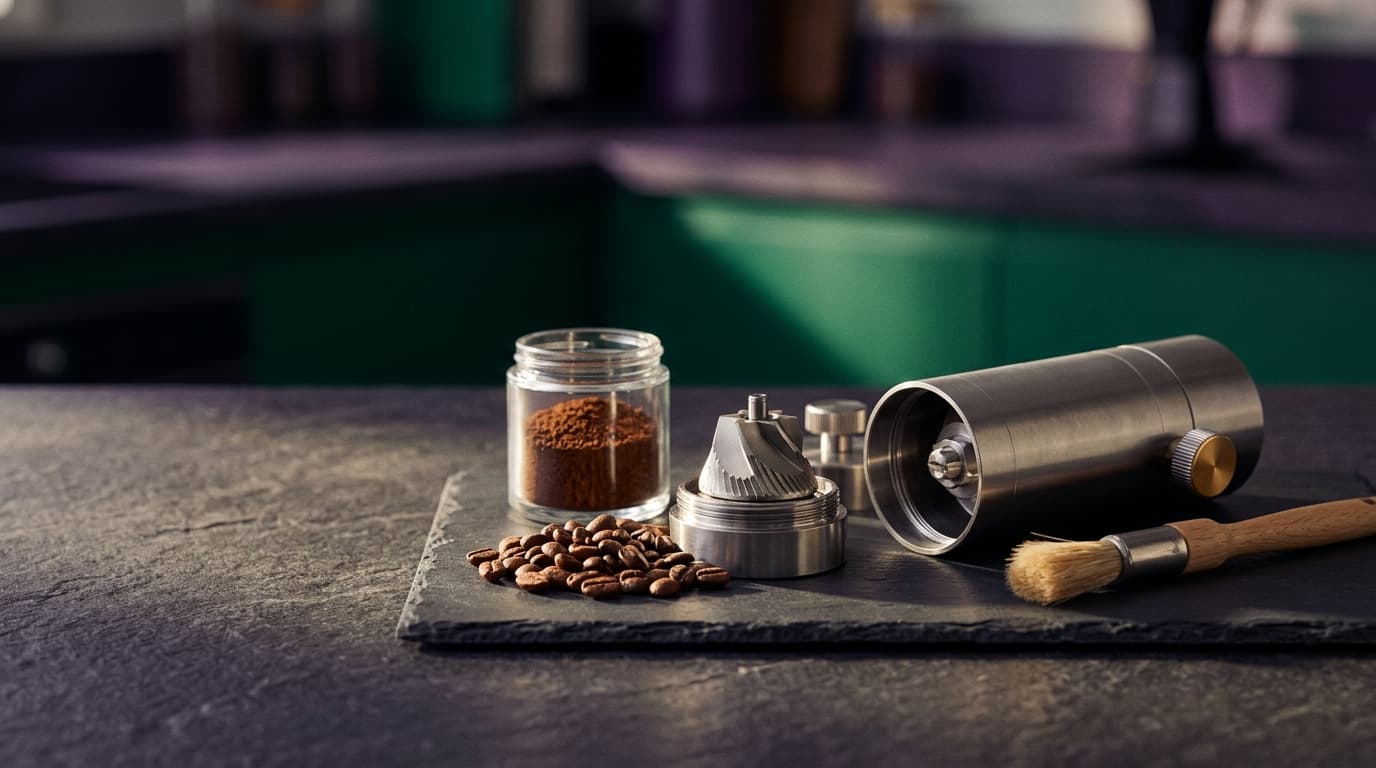
A manual hand grinder in that exact same price bracket has no motor, no wiring, and no circuit board. Almost every dollar goes directly into CNC-machined stainless steel burrs, a rigid aluminum body, and dual ball bearings that keep the shaft aligned.
Here is how that physical reality plays out in your morning cup, how long each option lasts, and where the daily trade-offs actually bite.
Cheap motors steal budget from burr steel
Grind consistency depends on sharp cutting edges and rock-solid burr alignment. You want coffee beans sliced into uniform particles, not crushed into random dust and jagged chunks.
In the sub-$100 electric category, most machines do not use sharp, machined steel burrs. Instead, they use dull, cast metal "block burrs" or small ceramic cones. Instead of slicing the beans, these blunt teeth smash them against each other. The result is a wide mix of sizes: large boulders that under-extract and sour your brew, alongside microscopic powder (called "fines") that over-extracts and adds harsh bitterness.
By contrast, hand grinders in the $40 to $90 range—from brands like Timemore or Kingrinder—regularly feature 38mm to 48mm stainless steel burrs cut on 5-axis CNC machines. Those burrs slice through coffee beans with minimal resistance and create a tight, predictable particle distribution.
If you brew with a paper filter, that difference shows up immediately. When you pair sharp manual burrs with The Budget Pour-Over Setup: Great Coffee for Under $50, water drains evenly in about three minutes. Run that same coffee through a sub-$100 electric grinder, and the flood of fines will clog the paper, stall the drawdown, and leave a muddy, bitter puddle in your dripper.
Plastic gearboxes create a built-in expiration date
Motor durability is the hidden failure point of cheap electric grinders.
Coffee beans—especially lightly roasted specialty beans—are dense and hard. Grinding them requires significant torque. Quality electric grinders achieve that torque using heavy, slow-turning motors paired with robust metal gears, which is why reliable entry-level electric units typically start around $150 to $200.
Sub-$100 electric grinders cut costs by pairing a cheap, high-RPM toy motor with plastic reduction gears. Every time you grind light-roast beans, those nylon teeth take the strain. Over a year or two of daily use, those gears strip, the motor burns out, or the burr wobble gets visibly worse. Once a budget electric grinder fails, replacement parts rarely exist; the entire unit goes straight into a landfill.
A quality manual hand grinder has no motor to burn out. The stainless steel shaft rests inside dual ball bearings mounted inside a rigid metal chassis. As long as you do not drop it on concrete or wash the bearings with soapy water, a metal hand grinder will perform the same way in year five as it did on day one.
The honesty check: hand grinding gets old fast for groups
Grind quality is not the only variable that matters at 6:30 in the morning. Convenience has real value, and hand grinders demand physical effort for every single cup.
Grinding 15 to 20 grams of medium-roast coffee for a single mug takes about 30 to 45 seconds of steady cranking. If you only brew for yourself, that is an easy, quiet morning routine. It produces zero motor screech and takes up almost no counter space.
Here is where that setup falls apart:
- Making coffee for guests: Grinding 60 grams of coffee for a full batch means filling, cranking, and emptying a hand grinder three separate times. Your forearms will feel it, and your guests will wait ten minutes for coffee.
- Dense, light roasts: Very light roasts are hard. Cranking through them requires genuine grip strength.
- Espresso tuning: Dialing in an unpressurized espresso basket requires ultra-fine grinds and micro-adjustments. While some sub-$100 manual grinders can grind fine enough—as discussed in my guide on Good Espresso at Home Doesn't Require a Four-Figure Machine—hand-cranking for 90 seconds per shot gets exhausting quickly.
- Large cold brew batches: If you want to brew a big batch using How to Make Clean Cold Brew at Home with Gear You Already Own, grinding 100 grams by hand is an absolute chore.
If your household drinks three or four large mugs of coffee every single morning, buying a budget electric grinder—or saving up for a $150+ workhorse—is often worth the drop in cup clarity simply to avoid the manual labor.
Retention and counter mess tell the rest of the story
Static and retained grounds are the final daily annoyance.
Sub-$100 electric grinders tend to have long, plastic internal chutes. As dry coffee passes through high-speed spinning burrs, static electricity builds up. Up to two grams of ground coffee can get trapped inside the internal chute during every run. That trapped coffee goes stale overnight and drops into tomorrow morning's fresh cup. Worse, fine chaff clings to the plastic collection bin and flies all over your countertop when you pull it out.
A manual hand grinder drops coffee straight down from the burrs into a screw-on metal catch cup. Retention is practically zero—what you put in is what you get out. Cleaning it requires nothing more than blowing out loose chaff or running a small dry brush over the burr teeth once a week.
The sub-$100 buying decision
If you want the best-tasting coffee possible for under $100, the path is clear:
- If you brew 1–2 cups at a time (pour-over, AeroPress, French press): Buy a metal hand grinder with CNC steel burrs (roughly $45 to $85). You will get grind uniformity that rivals $250 electric machines.
- If you brew full 8-to-12-cup pots for multiple people: Skip the cheap sub-$100 electric burr grinders. Either stick with standard pre-ground coffee from a local roaster until your budget allows, or stretch your spending up to the $150–$200 tier where electric motors and steel burrs actually hold up.
Prices fluctuate across retailers, so check current listings and look for CNC stainless steel burrs rather than ceramic parts before buying.
Keep reading
All posts
My Practical Home Coffee Setup: What's Worth It and What to Skip
A plain breakdown of the burr grinder, brewer, and beans in my daily morning coffee routine, including what is actually worth buying and what gear to skip.
August 2, 2026 · 3 min read